


Investing in Taiwan and Korea has been a sure-fire way for emerging market and Asia funds to top their respective sectors over recent years, but some have managed to beat their peers without needing to lean too heavily into either country.
Both sectors have benefited from the AI boom, with Taiwan’s TSMC now the largest company in both the MSCI Emerging Markets and MSCI AC Asia Pacific ex Japan indices. Just behind are Korea’s big two: Samsung Electronics and SK Hynix.
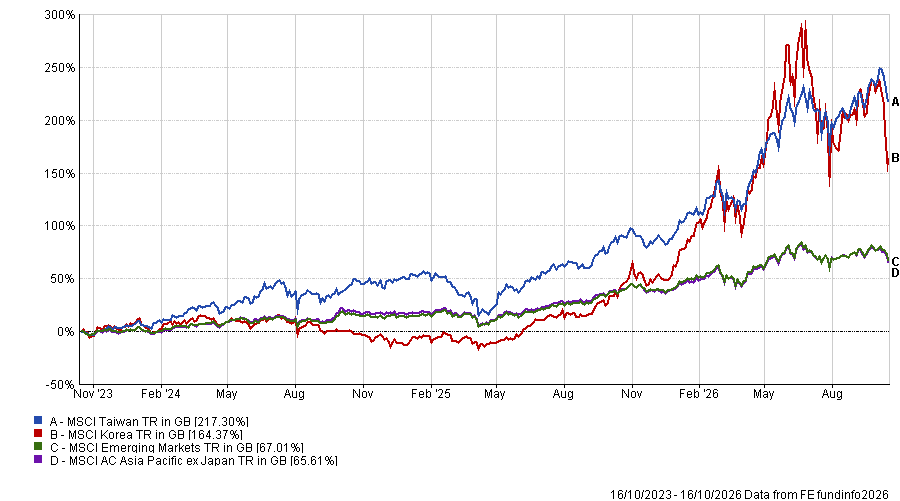
The boom in these companies has led to exponential growth in the two markets, with the MSCI Taiwan and MSCI Korea indices up 217.3% and 164.4% respective over the past three years, far outpacing the more general emerging market and Asia benchmarks.
Performance of indices over 3yrs
Source: FE Analytics
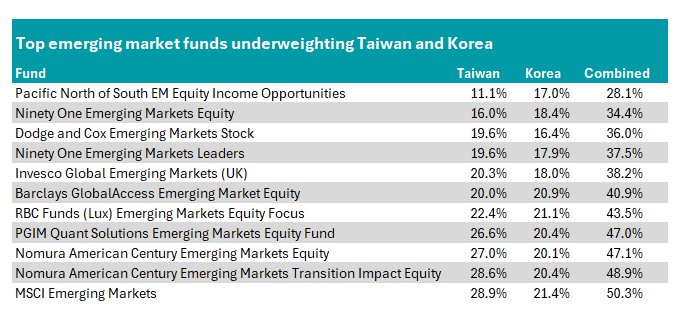
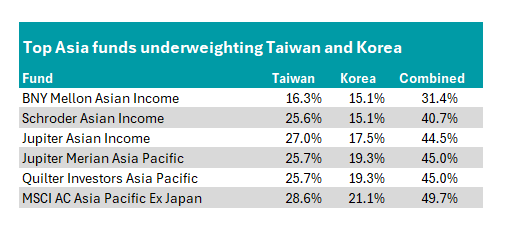
The MSCI Emerging Markets index has a combined weight of 50.3% to the two countries, with Taiwan accounting for 28.9% and Korea 21.4%. This dips slightly for the MSCI AC Asia Pacific ex Japan index, with a 49.7% allocation split 28.6% and 21.1% respectively.
Yet it has not been imperative for funds to own these countries to make money, research by FE Trustnet has found. Of the 34 qualifying funds* in the top quartile of the IA Global Emerging Markets sector over the past three years, 10 are underweight both countries.
Pacific North of South EM Equity Income Opportunities had the lowest weighting to the two countries, with a combined 28.1% invested in Korean and Taiwanese stocks.
Run by Kamil Dimmich, Robert Holmes and FE fundinfo Alpha Manager Matthew Linsey, the portfolio has made 74.4% over the past three years despite its market underweights.
However, this is not to say the fund is against these markets. Korea is its largest country weighting, with Taiwan in third place. China is in the middle of the two. Samsung Electronics is its largest position at 3.2% of the fund, with SK Hynix also in the top 10, although both are much smaller than their index weightings.
It is the only income specialist on the list below. In second place, Ninety One Emerging Markets Equity has 16% in Taiwan and 18.4% in Korea, meaning its total exposure to the two stands at 34.4%. Its largest weighting is to China, where 24% of the portfolio is allocated.
The fund has been the second-best performer in the IA Global Emerging Markets sector over three years, up 100%. Managed by Archie Hart and Varun Laijawalla, it is rated by analysts at Barclays Invest who placed it on the bank’s best-buy list.
“We believe the team at Ninety One is one of a small number in the marketplace that has the breadth, depth, experience and expertise to navigate this space,” they said, noting that the long-term performance validates its process of buying high-quality companies that are attractively valued.
Source: FE Analytics
The most popular fund on the list among fund pickers, however, is Invesco Global Emerging Markets (UK), which is tipped by researchers at AJ Bell, Fund Research Centre and FundCalibre. It also appears in the Titan Square Mile Academy of Funds and the FE Investments Approved List.
It is run by a team of three including Alpha Managers William Lam and Charles Bond. Ian Hargreaves is also co-manager, although he is to retire next year, with Matthew Pigott and James Dermottroe replacing him. It has an impeccable track record, generating a top-quartile return over one, three, five and 10 years.
While Taiwan and Korea make up more than 50% of the emerging market benchmark, they are not far behind in Asia indices either.
Turning to the IA Asia Pacific Excluding Japan sector, of the 26 qualifying funds* from the peer group, just five are underweight both countries.
BNY Mellon Asian Income stood out for its willingness to be different. The fund has just 31.4% invested between the two countries, more than 9 percentage points less than any others on the below list.
Source: FE Analytics
Up 72.9% over three years, the fund is headed by Zoe Kan. It is heavily weighted to TSMC (9.4%) and Samsung Electronics (9%) but does not invest in much from Taiwan and Korea outside of these two large holdings.
Income funds dominated the list, with Schroder Asian Income and Jupiter Asian Income also underweight both countries.
The latter is up 91.7% over three years. It is run by Jason Pidcock, who used to run the BNY Mellon Asian Income fund before leaving the firm. He is joined by co-manager Sam Konrad.
It is heavily favoured by analysts, appearing on the best-buy lists of AJ Bell, Hargreaves Lansdown and FundCalibre, as well as Titan Square Mile and RSMR.
Hargreaves analysts said it is a “great way to access Asia’s exciting growth potential, along with a regular income”, noting that Pidcock has invested in Asian income for a long time – something “few other managers” have done.
One who has, however, is Richard Sennitt, who has been in charge of the Schroder Asian Income portfolio since 2001. It is backed by analysts at FE Investments, Titan Square Mile, RSMR and the Fund Research Centre, the latter of whom said Sennitt is a “highly experienced, Asian-trained fund manager” who is supported by a “very well-resourced team at Schroders”.
“As an access point for Asian yielding equities, we feel that the fund has proved its worth,” they said.
*Country weighting data is not available on FE Analytics for all funds in the top quartile of either the IA Global Emerging Markets or IA Asia Pacific Excluding Japan sectors. As such, the number of funds in this study is lower than the total number of portfolios in the top quartile of the peer group over three years.