






Long-term outperformance does not mean a fund has delivered smooth returns every year and 2025 was a difficult one for some of the most popular multi-asset funds, FE Analytics data has shown.
Several top-quartile multi-asset funds over 10 years struggled in 2025, with markets experiencing volatility driven by geopolitical tensions, sticky inflation and a sharp rotation away from growth-heavy areas.
Twelve funds across IA Mixed Investment 0-35% Shares, IA Mixed Investment 20-60% Shares, IA Mixed Investment 40-85% Shares and IA Flexible Investment sat in this camp, including Baillie Gifford Managed and funds from Liontrust’s Sustainable Future range, as the below table shows.

Source: FE Analytics
The largest fund in the table is the £4.1bn Baillie Gifford Managed, which sits in the IA Mixed Investment 40-85% Shares sector and gained 8.9% in 2025.
Co-managed by Iain McCombie and Steven Hay, it is designed to be a one-stop, growth-oriented portfolio built on Baillie Gifford’s bottom-up stock-picking philosophy, with top holdings including notable artificial intelligence (AI) players ASML, TSMC and Amazon.
Its typical allocation to equities ranges between 65% and 85%, with 10% to 30% in bonds and 0% to 10% in cash. It has a neutral position of 75% in equities and 25% split between bonds and cash.
The fund typically benefits when growth stocks lead, and lags in value-driven markets. As such, of the funds in the table, Baillie Gifford Managed suffered most in the 2022 market, losing almost 25%.
During the year, tech stocks and other growth sectors struggled as unexpectedly high inflation caused central banks to rapidly pivot to aggressive rate hikes. These impact growth stocks significantly, as these companies are valued on the value of future earnings: something that is eroded if investors can make good gains from lower-risk options such as bonds.
When the fund was put to fund pickers in Trustnet’s ‘buy, hold or fold’ series last year, most experts opted to ‘hold’. They cited its strong long-term credentials, noting this wins out when balanced against the short-term volatility.
Meanwhile, the £637.2m Liontrust Sustainable Future Managed Growth returned 4% in 2025, placing it in the fourth quartile of the IA Flexible Investment sector.
Sustainable funds have had a tough time since late 2022, when pushback from sustainability sceptics – more formally known as the ‘anti-ESG movement’ – alongside worsening geopolitical tensions and the cost-of-living crisis, prompted a swell of pragmatism and outflows from sustainable funds that have so far shown no signs of slowing.
It is co-managed by Peter Michaelis, Simon Clements and Chris Foster and sits within Liontrust’s Sustainable Future range, which targets long-term structural growth themes, including resource efficiency and improved health.
The fund’s focus on sustainable growth – which includes an almost 30% weighting to the telecom, media and technology sector – contributed to its weaker short-term performance. Alphabet is its largest holding at 5.4%.
The performance of the healthcare sector – to which the fund had a 9% overweight at the time of producing the report – also weighed on returns, due to subdued post-Covid investment, weak demand and ongoing US regulatory uncertainty, the managers said.
In contrast, Liontrust Sustainable Future Managed, which sits in the IA Mixed Investment 40-85% Shares sector, gained 0.6 percentage points more than its stablemate in 2025 – although its 10-year return is some 57 percentage points lower at 121.2%.
It is a bigger fund with just shy of £2bn in assets and also sits in the Sustainable Future range, co-managed by Michaelis and Clements.
The fund’s largest sector exposure is also to the information technology sector at 17.6%, balanced with more defensive positions in financials (17%) and healthcare (13.9%).
Analysts at FundCalibre said Liontrust Sustainable Future Managed has proven its ability to outperform in the past two decades and “is backed by one of the most experienced and well-resourced teams around”.
“The fund has a well-defined process which has emphatically proven sustainable companies have better growth and are more resilient than the market gives them credit for – having delivered excellent performance through a high conviction portfolio,” they added.
However, the smallest one-year return across the four multi-asset sectors was made by Margetts MGTS Sentinel Enterprise, which 2.4%.
The £100.3m portfolio, run by FE fundinfo Alpha Manager Gerrit Smit since 2016, is a concentrated global equity approach with the flexibility to adjust cash from a typical low level up to 30% in periods of heightened market risk.
While three of the Magnificent Seven – Alphabet, Microsoft and Amazon – feature in its top holdings, the fund’s biggest sector exposures are skewed toward consumer discretionary (20%), technology (19.5%) and financials (17.6%).
Long-term performance includes several first-quartile years – including a 157.9% gain over 10 years (calculated to year-end 31 December 2025) – but returns have proven volatile at times, including an almost 20% decline in 2022.
While these long-term outperformers struggled last year, other funds saw something of a resurgence in 2025, with some of the strongest one-year returns across the multi-asset sectors coming from GMO Global Real Return UCITS, Scottish Widows Regular Income and EF 8AM Balanced.
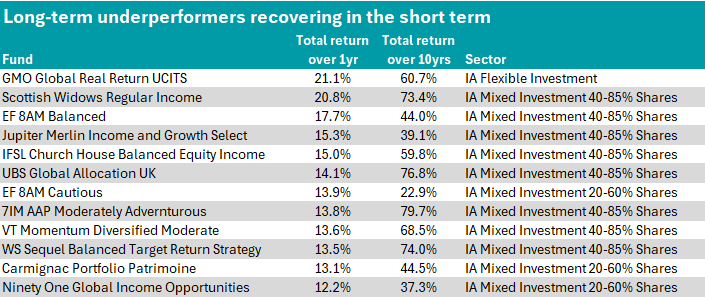
Source: FE Analytics
As part of this series, Trustnet looks at the funds that have strong long-term performance but struggled in 2025, as well as those at the bottom of the rankings over the long term making a comeback. Previously we have looked at global equity income, the US, Japan and small-caps.