






Six global funds are offering investors a middle ground between lower costs and the potential for excess long-term returns from skilled active managers, according to Trustnet research.
In this ongoing series, we screen Investment Association (IA) sectors for funds that sit in the cheapest decile of actively managed strategies –measured by ongoing charge figure (OCF) – while also ranking in the top decile of their overall sector for 10-year returns.
Overall, the cheapest decile of funds in the IA Global sector over the assessed period logged a stronger average return than those invested in the most expensive decile – 241.1% versus 172%.
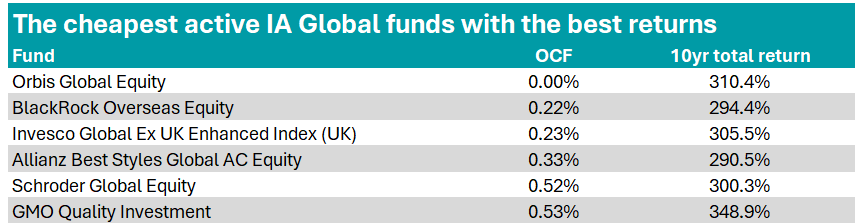
Among IA Global funds, only six qualified, as shown in the table below.
Source: FE Analytics
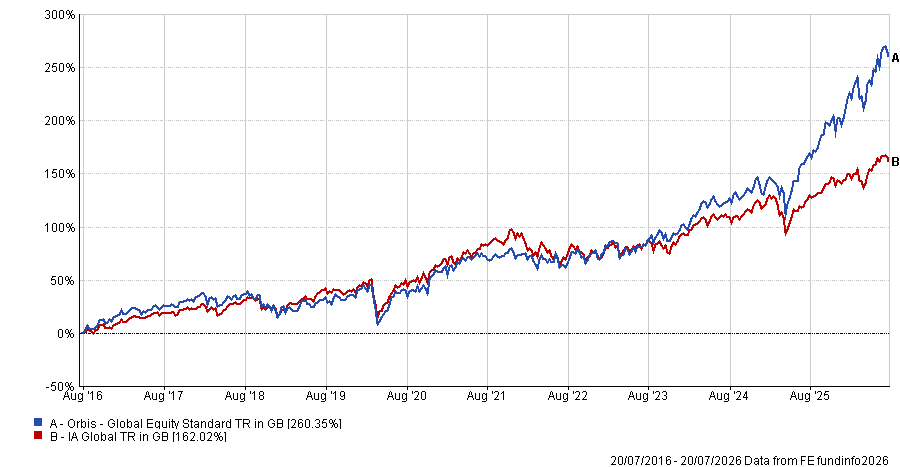
The Orbis Global Equity fund stands out immediately, seemingly charging 0% in exchange for the second-best 10-year return in the table at 310.4%.
However, the fund is not technically free. Instead, it operates a performance-linked fee model: if it fails to beat its benchmark, the MSCI World index, it does not charge a fee, and 40% of any underperformance is paid back. When it does outperform, 40% of the excess return is taken as a performance fee.
The fund has logged a steady increase in assets, with an acceleration from around £250m in February 2025, to knocking on the door of £1bn today.
The £962.7m strategy is mostly invested in the US at 45% but this is a significant underweight versus the benchmark’s 72%. It is also overweight the UK at 13% versus 3% of the benchmark.
These regional positions arguably feed into the fund’s sector exposures, with technology at a low 17% versus 30% of the benchmark and industrials at 23% (versus 12% for the index). Even so, several of its top 10 holdings are clear AI-related plays, including Samsung Electronics and TSMC.
Last year, the fund attracted attention for logging a strong performance without owning any Magnificent Seven stocks.
Orbis Global Equity added £228m of net new money in 2025.
Performance of the fund vs sector over 10yrs
Source: FE Analytics
Putting the Orbis strategy’s unique fee structure to one side, then the cheapest active fund in the table is BlackRock Overseas Equity, with an OCF of 0.22% and a 10-year return of 294.4%.
The £491m strategy has been managed by Steve Walker since 2013 and targets both growth and income by investing at least 70% of its total assets in iShares funds.
This indirect approach gives the fund broad diversification while maintaining a low cost profile.
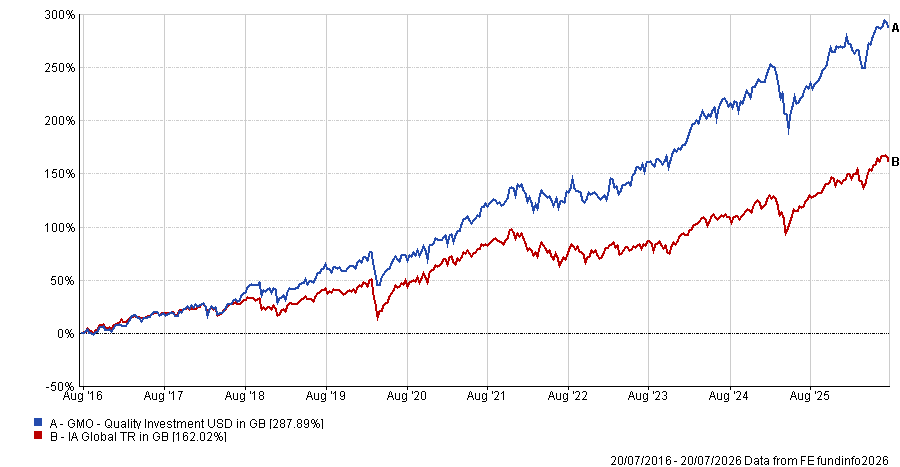
Meanwhile, the strongest performer in the table is the $8.7bn GMO Quality Investment fund. It delivered a 10-year return of 348.9% but it is the most expensive fund in the table, with an OCF of 0.53%.
The strategy holds a five-Crown FE fundinfo Rating and is co-managed by Tom Hancock, Anthony Hene and Ty Cobb, who target capital accumulation through a concentrated portfolio of up to 50 high-quality global companies selected for their attractive valuations and strong fundamentals.
Indeed, of the funds in the sector, it has one of the highest correlations to quality stocks over the past three years.
Looking at the calendar-year returns over the decade, GMO Quality Investment has posted a return in the third decile or better in six of the 10 years. It has also maintained a maximum crown rating since its track record began in 2022 and has been highlighted for the consistency of its longer-term performance.
Titan Square Mile analysts said: “Recognised for its fundamental and quantitative research, the team combines extensive experience across investment styles – indeed, the managers have the ability to adjust the style of the portfolio by tilting weights to the three underlying buckets (quality growth, core quality and quality value) with the aim of outperforming in different market environments, which we believe gives the fund an edge over peers.”
As a result, the portfolio typically excels in risk-off environments, where the market values company fundamentals over sentiment or optimism, the analysts said.
In the long-term, they argued the fund’s ability to avoid full participation in market downturns should enhance returns.
Performance of the fund vs sector over 10yrs
Source: FE Analytics
Schroder Global Equity is another large actively managed fund with an Alpha Manager at the helm (Alex Tedder) that has posted a strong 10-year return for a lower cost than many of its peers.
The strategy targets capital accumulation through a diversified portfolio of global companies and has a growth tilt. Its highest sector weighting is to technology at 33.6%, with top holdings including Magnificent Seven stocks Alphabet, Nvidia and Apple.
Titan Square Mile analysts said: “The strategy’s focus on identifying a ‘growth gap’ is both intuitive and repeatable and has proven effective across a range of market environments, while the teams’ disciplined approach to stock selection and portfolio construction, grounded in long-term fundamentals, has consistently delivered strong risk-adjusted returns, with a clear emphasis on earnings as the primary driver of outperformance.”
They noted that Schroder Global Equity may lag during momentum-driven markets, when valuations become detached from fundamentals, but they viewed this as a sign of its disciplined process rather than a weakness.
Other actively managed funds posting strong long-term returns for a lower OCF are Invesco Global Ex UK Enhanced Index (UK) and Allianz Best Styles Global AC Equity.