


Sustainable funds – those prioritising investing in companies with strong environmental, social and governance (ESG) credentials – have fallen out of fashion in recent years as investors have shifted their focus toward more immediate concerns, such as geopolitical fragmentation, sticky inflation, rising interest rates and slowing economic growth.
Yet demand has not dried up entirely, with some investors continuing to back funds investing in companies with strong sustainable as well as financial fundamentals.
Investor appetite is, however, more selective, with the £3.7bn Royal London Sustainable World Trust fund one of the most-researched funds on Trustnet over the past 12 months.
The multi-asset vehicle is co-managed by FE fundinfo Alpha Manager Mike Fox, alongside George Crowdy, Sebastien Beguelin and Daphne Tsang, screening companies with strong ESG-related standards. Prospective holdings are expected to pass both a sustainable and financial assessment, with top holdings in the portfolio including Amazon, TSMC and Standard Chartered.
With the fund dating back to 2009, Rob Morgan, chief analyst at Charles Stanley, noted it “built a reputation long before sustainable investing became de rigueur”.
Then, when sentiment toward sustainable funds began to sour in 2022 and mass outflows kicked in, the fund managed to adapt to the new market regime while maintaining strong returns.
It has posted first quartile returns in the IA Mixed Investment 40-85% Shares sector over one, three, five and 10 years to the end of September 2026, gaining 187.5% over the decade.
Performance of the fund vs sector over 10yrs
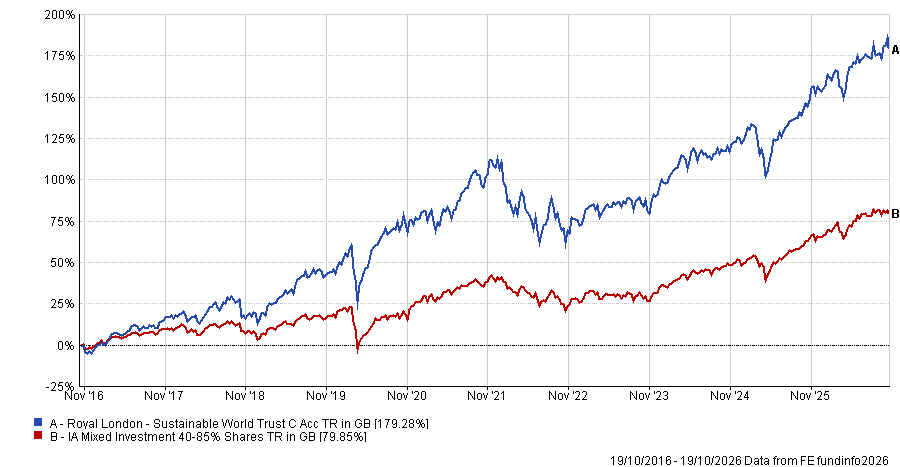
Source: FE Analytics
Darius McDermott, managing director at FundCalibre, said: “The fund proves investors do not have to sacrifice returns for their principles – sustainable funds have had a difficult time but savers’ appetite for money that does more than grow but also does some good for the world has not gone away.”
Ben Yearsley, director at Fairview Investing, said he regularly uses this fund for non-sustainable clients as well as sustainable ones, “as it’s good enough to merit inclusion in ‘normal’ portfolios”.
However, investors should not have all their eggs in just one basket, no matter how impressive the fund’s performance has been. As a result, Trustnet asked fund selectors to suggest alternative sustainable funds for those who want to maintain a commitment to sustainability-focused objectives within their portfolios.
Staying within the IA Mixed Investment 40-85% Shares sector, McDermott first suggested the £1.7bn Liontrust Sustainable Future Managed fund.
The fund – which is co-managed by Peter Michaelis and Simon Clements – has had a rockier time of it as its quality-growth and mid-cap bias “fell out of fashion”. It sits in the fourth quartile for returns over five years but maintains a first-quartile return over 10 years, gaining 107.7% over the full decade, showing that its recent woes have been compensated for over the long term.
This volatility has made it more unpopular among investors, as it logged £321.8m in outflows in the first half of this year. McDermott confirmed this “makes it the contrarian choice”.
However, across discrete annual calendar returns, the Liontrust strategy has also logged some stronger years – for example, it limited losses to 0.5% in 2018 while Royal London Sustainable World Trust lost 3.1% and the sector average was a 6.1% loss.
“This fund takes a similar thematic approach [as the Royal London strategy], backing companies benefiting from long-term shifts such as better healthcare, cleaner energy and greater efficiency, with a meaningful bond allocation,” McDermott said.
Current themes in focus include resource efficiency – such as energy usage and water management – alongside affordable healthcare and enhanced digital security.
McDermott also suggested Rathbone Greenbank Strategic Growth, which is co-managed by David Coombs and Will McIntosh-Whyte and has almost £260m in assets.
Similar to other sustainable funds, it has a bias away from less sustainable sectors, such as oil and gas, defence and mining, while targeting technology, healthcare and industrial names across eight sustainable development categories which link to the UN Sustainable Development Goals, including energy and climate, health and wellbeing and innovation and infrastructure.
Alongside equities and bonds, the fund also holds alternatives, such as gold, which McDermott argued makes it a more diversified option for investors’ portfolios. “It should also therefore be less volatile,” he said.
Over five years, the fund has logged a volatility of 8.5% versus 12.6% for Royal London Sustainable World Trust. “The trade-off is it is unlikely to keep pace in strong equity markets,” he said.
Indeed, its roughly 60% allocation to equities is the lowest of all funds mentioned. This has weighed on performance, with Rathbone Greenbank Strategic Growth logging one of the weakest returns over five years at 8.4%.
Meanwhile, Yearsley suggested the smaller £88.5m CT Sustainable Universal MAP Growth fund as a potential lower-cost alternative, with an ongoing charges figure (OCF) of 0.39% versus 0.77% for Royal London Sustainable World Trust.
Managed by Eloise Robinson since late 2024, the fund – which sits in the CT Sustainable Universal Multi-Asset suite launched in 2019 – invests in companies providing solutions to ESG-related challenges, including energy transition, resource efficiency and sustainable infrastructure.
The suite applies a tri-pillar approach to investing: it ‘avoids’ companies that don’t align with ESG criteria, such as fossil fuels; ‘invests’ in companies deemed to be making a positive and sustainable contribution and ‘improves’ portfolio holdings by engaging with companies on best practice and management of ESG risks.
To make assessments of company eligibility and performance, the management team utilises international frameworks such as the UN Sustainable Development Goals.
Similarly to the Royal London strategy, the fund counts hyperscalers and AI-related plays among its top 10, such as Microsoft and TSMC, alongside more defensive names across healthcare (Eli Lilly) and financials (Mastercard).
Morgan looked away from mixed asset funds, suggesting Ninety One Global Sustainable Equity, which sits in the IA Global sector and is co-managed by Stephanie Niven and Miles Hamilton.
“The fund favours quality-growth businesses, has a relatively concentrated portfolio and builds positions around long-term sustainability themes,” Morgan said.
However, unlike the Royal London Sustainable World Trust, the £183.7m Ninety One strategy has struggled, sitting in the third or fourth quartile of the IA Global sector over one, three, five and 10 years, gaining 145.4% over the decade.
The performance gap is largely explained by the difference in mandate. Ninety One Global Sustainable Equity has stricter sustainability constraints, specifically investing in companies that contribute to positive environmental change through sustainable decarbonisation.
It has adopted the Sustainability Impact under the Financial Conduct Authority’s (FCA) SDR rule, which requires funds to demonstrate real-world positive sustainability outcomes from its investments.
Royal London Sustainable World Trust, by contrast, has adopted the broader Sustainability Focus label, which requires funds to invest in companies making a positive contribution to one or more sustainability themes.
“While Royal London Sustainable World Trust is perhaps a more pragmatic sustainable fund, Ninety One Global Sustainable Equity could be seen as the purer impact strategy,” Morgan said.