






In recent years, the US equity market has become increasingly concentrated, with the Magnificent Seven accounting for a substantial share of index returns.
However, Ibrahim Kanan, portfolio manager of BlackRock’s US Flexible Equity Fund and US Dynamic Fund, argues there is opportunity elsewhere in the market, as earnings growth outside of the mega-caps begins to recover.
“In 2023 and 2024, the Magnificent Seven grew their earnings by almost 40% a year. If you then take the Magnificent Seven out of the earnings growth of the S&P 500, earnings growth would have been negative in those two years,” he said.
Now, however, he said many of these businesses are “coming out of an effective recession” – with valuations that are lower than the rest of the market. “In 2025, they finally inflected positive and in 2026 the market is expecting them to grow at a similar pace.”
He acknowledged that the Magnificent Seven “remain incredibly strong businesses”, with both of his funds including a number of the mega-caps in their top 10 holdings.
“However, it is increasingly important to risk manage mega-cap and artificial intelligence (AI) exposures while also capturing real differentiated upside,” Kanan said.
Against this backdrop, he is focusing on companies outside the index leaders that are benefiting from industrial recovery, AI‑related infrastructure demand and overlooked defensive trends.
Wesco
Kanan first highlighted a more recent investment that he believes is set for recovery: Wesco. The Fortune 500 industrial distributor’s core business continues to benefit from long‑term themes such as the digitalisation of procurement processes and the modernisation of utility grids.
“When you look at the US industrial and manufacturing landscape, it has been in something of a recession for the past two years – Wesco is exposed to those end markets and has been dealing with these issues,” Kanan noted.
“Over the course of 2025 and 2026 Wesco saw its revenue accelerate as we are seeing more industrial action in the US. Part of this is being driven by AI spend, but not all – for example, pharmaceutical companies are building more manufacturing plants in the US, particularly along the west coast.”
However, the AI build-out is set to be one of the company’s main sources of growth.
Wesco acquired network, security, electrical and utility power product distributor Anixter in 2020, allowing the company to significantly expand its communications and security portfolio which, in turn, is boosting its relevance in data centre construction and other AI-driven infrastructure.
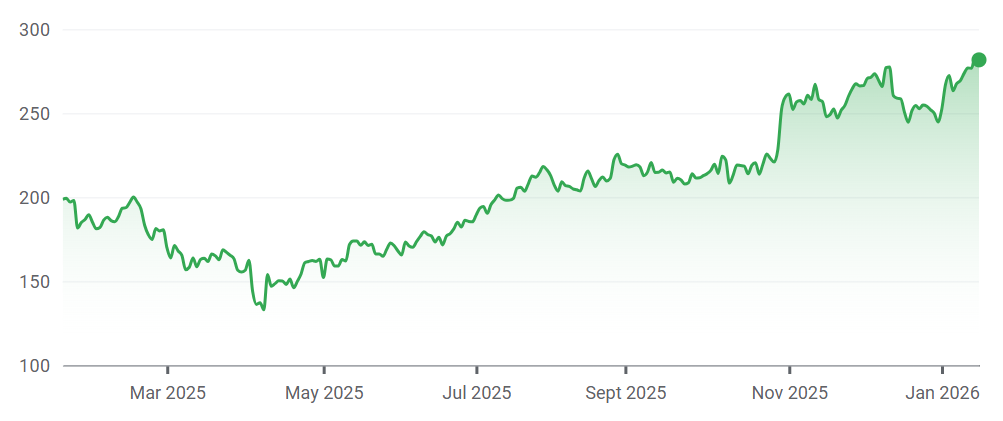
In October 2025, the company reported a record third quarter, with net sales up 12.9% year-on-year at $6.2bn. Data centre-specific sales reached £1.2bn – a 50% year-on-year increase.
The company’s share price is up 41.6% over one year and 235% over five years.
Stock price performance over 1yr
Source: Google Finance
Ciena
Another pick by Kanan was Ciena, a US provider of optical networking, high-capacity connectivity systems and network automation software.
It, too, has increasing involvement in the build-out of AI-driven infrastructure, given its portfolio, which includes data centre interconnect WaveServer.
“When I look at the US equity market’s AI spend, a lot of it has gone to big companies like Nvidia, backing GPU production and the erection of data centres,” said Kanan.
“But what we have noticed over the past two years is that data centres are currently running below 50% utilisation. Companies like Ciena are useful as it can ultimately get the data to the GPU faster.”
Ciena reported that its 2025 revenue reached $4.8bn – up from $4bn in 2024.
The company expects this level of growth to continue, forecasting 2026 revenue in the range of $5.7bn to $6.1bn.
“With Nvidia at around $5trn market cap and Ciena closer to $20bn, [Ciena’s increasing usefulness] is a good example of how the AI market is set to broaden out over the next few years,” he said.
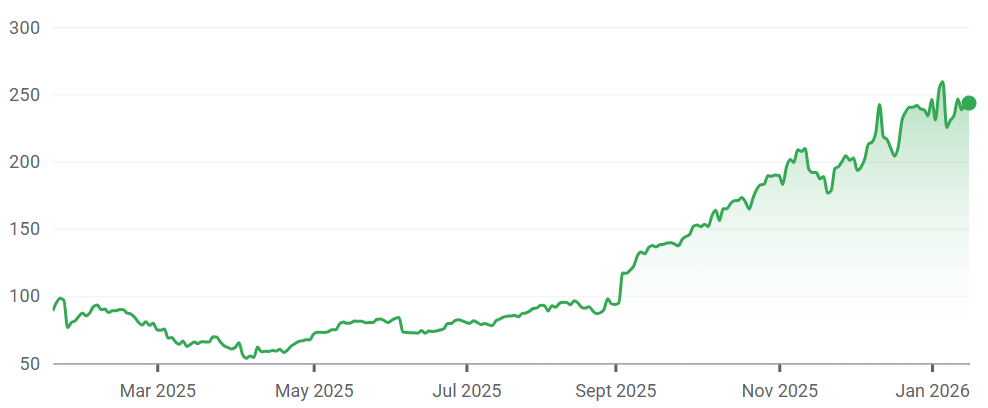
The company’s share price is up 174.5% over one year and 342.3% over five years.
Stock price performance over 1yr
Source: Google Finance
Cardinal Health
The BlackRock manager said he also sees more opportunities in the US healthcare sector, a market that has been “largely forgotten” by investors, but that is “set to benefit from a broadening market.”
“It is also currently trading at a big discount,” he noted. However, it is important to be selective, he said, currently preferring distributors over large pharma stocks, which face significant revenue patent cliffs in the short to medium term.
Kanan highlighted top 10 portfolio holding Cardinal Healthcare, which is one of three pharmaceutical distributors in the US.
“If you believe healthcare is a future-focused theme and that we are going to consume more drugs as we get older, a drug distributor is a great way to get exposure to that without having to worry about things like patent revenue cliffs,” Kanan said.
The company is in the process of implementing a multi-year plan to increase capacity across its network, as well as investing in new technologies to improve efficiencies, such as Vantus HQ, a proprietary ordering platform for retail pharmacists to search products, track orders and access reporting.
For the full year 2025, the company returned $1.3bn to shareholders through dividends and share repurchases.
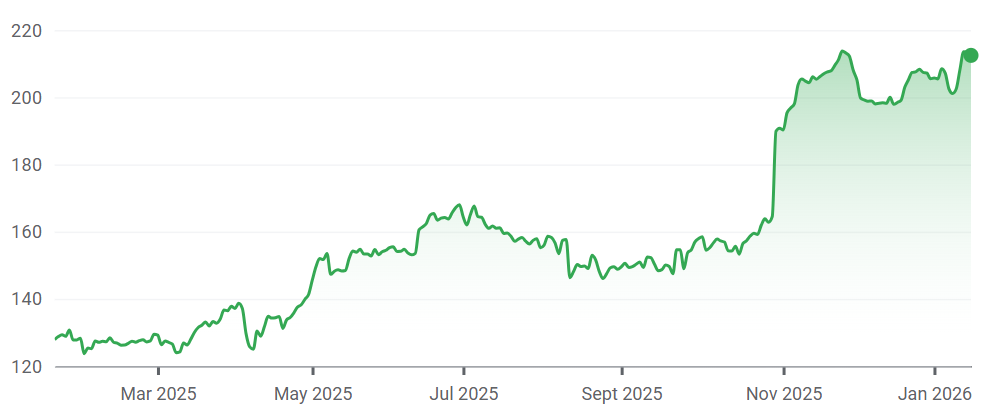
“People have become so used to seeing the big numbers from the Magnificent Seven and AI-related companies, yet Cardinal Healthcare has returned 68% over the past year,” Kanan said.
Cardinal Healthcare’s share price is up 66.2% over one year and 283.6% over five years.
Stock price performance over 1yr
Source: Google Finance
AppLovin
Kanan said that he also looks for companies that are leveraging AI within their existing operations to gain a competitive advantage.
One example is AppLovin, a mobile technology and advertising company. It was founded in 2012 and originally focused on building tools for mobile app marketing and monetisation.
“The company has since built an archive of data on over a billion people worldwide through exposure to its gaming apps and it is now utilising AI to ensure it can target these users with tailored advertising,” Kanan explained.
In early 2025, AppLovin sold its mobile gaming business to focus on AI-driven ad-tech via its AXON AI engine.
“As such, companies with large marketing budgets are selecting AppLovin alongside Meta and Google to advertise. AppLovin is a $200bn market cap company that is effectively competing against those bigger giants.”
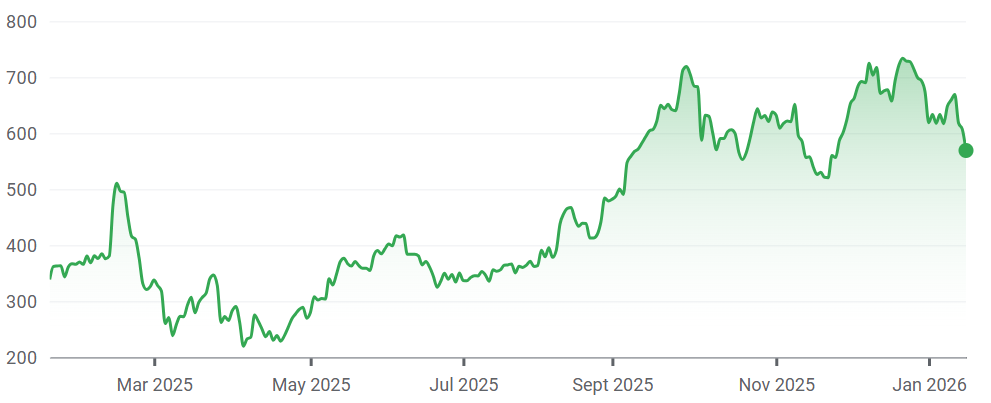
In the third quarter of 2025, AppLovin reported a 68% year-on-year revenue growth to $1.4bn. Its share price over one year is up 68.1% – surging to 832.4% over five years.
Stock price performance over 1yr
Source: Google Finance