






Emerging markets remain one of the most diverse and volatile areas of global equities, shaped by different political regimes, economic cycles and local policies.
As a reflection of this, funds that invest in this side of the world are more volatile, too.
To assess which delivered high returns consistently, Trustnet compared the discrete annual returns of these emerging market funds against the sector’s most common benchmark, the MSCI Emerging Markets index, over the past decade.
The analysis found that six actively managed funds outperformed the index in at least seven of the past 10 calendar years, with Artemis SmartGARP Global Emerging Markets Equity beating it in nine.

Source: FE Analytics. Figures highlighted in red represent years in which a fund underperformed MSCI Emerging Markets.
The Artemis strategy is the second-strongest long-term performer in both the table above and the sector, posting a 234.9% 10-year return to the end of 2025.
While it beat the MSCI index in nine years, it was the only fund in the table to fall short in 2020, with a loss of 0.4% as the Covid-19 pandemic took hold.
However, the fund has also demonstrated resilience when global equity markets have suffered. In 2022, a difficult year for global equity markets, the Artemis fund limited losses to 5.2% while MSCI Emerging Markets shed 10%.
RMSR analysts said the strategy has been vulnerable at market inflection points or during periods of economic stress, although “the management team have now refined the process to reduce the impact of rapid changes in market sentiment”.
Managed by FE fundinfo Alpha Manager Raheel Altaf since its 2015 launch, the £2.6bn strategy applies Artemis’ SmartGARP quantitative process, screening for companies that are undervalued relative to their growth potential, with a strong emphasis on earnings revisions, momentum and macroeconomic trends.
As such, its portfolio is currently tilted toward themes such as technology innovation, infrastructure improvement and the rise of domestic brands, with Samsung Electronics, Taiwan Semiconductors (TSMC) and Taiwanese cloud-infrastructure company Wiwynn some of its largest positions.
Artemis SmartGARP Global Emerging Markets Equity has been recognised by fund selectors as a strong option for emerging market exposure and was one of the most bought strategies in 2025.
However, top of the sector table for total 10-year return over the assessed period was Nomura Emerging Markets, gaining 257.3%. It also beat the MSCI Emerging Markets index in eight of those years and was the best-performing fund in the table last year.
The £155.8m fund’s ‘I’ share class was converted from a UCITS structure to a SICAV in 2020 and since then, it has been managed by Liu-Er Chen. However, its track record stretches back to 2009, when it was originally launched.
The next strongest long-term performer is the £1.3bn Invesco Global Emerging Markets (UK) fund, which gained 215.8% over the assessed 10-year period. As the table shows, it is also one of the most consistent, beating the index in seven of those years.
The strategy is co-managed by Alpha Managers Charles Bond and William Lam, alongside Ian Hargreaves and Matthew Pigott. The team targets undervalued companies in unloved areas of the market, with a preference for cash-generative businesses with strong balance sheets. This approach has generated a portfolio of 58 stocks with a weighted average market capitalisation of £208.5m.
Its largest position is in TSMC, although the fund remains slightly underweight relative to the index.
Analysts at Titan Square Mile noted that significant inflows in 2025 led to the management team raising both their market cap threshold and minimum daily liquidity requirements when selecting positions, pushing the fund “toward larger, more liquid names and reducing its ability to take meaningful positions in smaller, higher-conviction ideas”.
The analysts said it remains an attractive value-oriented strategy for long-term investors seeking exposure to emerging markets.
Looking at performance in the shorter-term, Principal GIF Origin Global Emerging Markets posted one of the strongest 2025 returns in the table, gaining 40.2% – a top-three return in the whole sector last year.
The small fund, which has £53.3m in assets and is co-managed by Chris Carter, John Birkhold and Tarlock Randhawa, has similar holdings to the previous two funds mentioned and has also committed to the AI build-out through its exposure to TSMC, Samsung Electronics and South Korean semiconductor company SK Hynix.
This focus on AI is similarly expressed through its sector allocations, in which the largest weighting is to information technology.
The other two funds in the table are GAM Sustainable Emerging Equity and Allianz Emerging Markets Equity.
The former has been highlighted as one of nine in the sector to deliver top-quartile returns over one, three, five and 10 years.
Meanwhile, the £153.5m Allianz strategy boasts a 250-stock portfolio and can invest up to 20% in developed markets.
Finally, not all funds in the sector have 10 years of data but have still managed to consistently outperform – for example, Pacific North of South EM All Cap Equity has beaten MSCI Emerging Markets in eight years since its inception in 2017.
Performance of the funds vs sector, 2016-2025
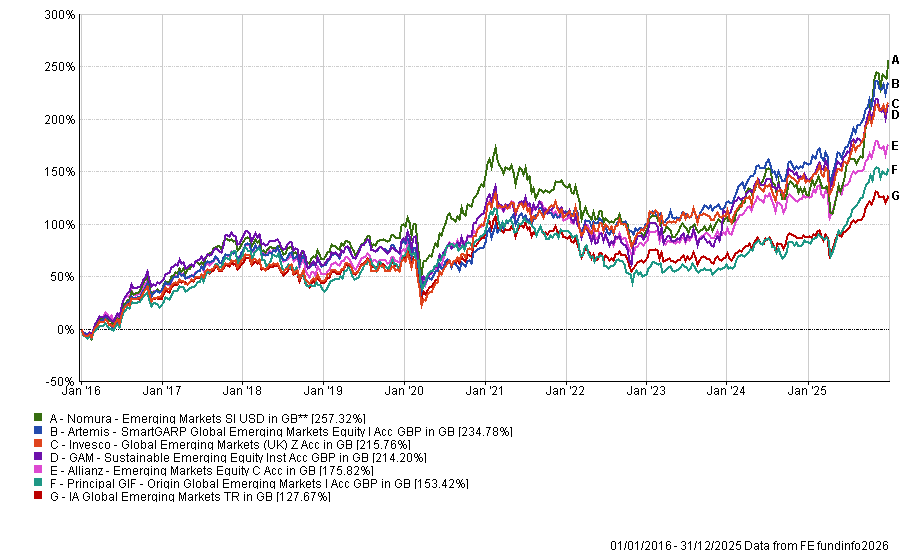
Source: FE Analytics