






Almost half of Janus Henderson’s funds failed to achieve a ‘good’ rating in its 2026 value assessment, with 28 strategies placed on an amber rating, meaning they are being monitored and are not yet deemed to offer good value for money.
Last year, the firm had placed 27 of its then-59 funds under review, suggesting limited overall improvement despite a series of fee cuts, process changes and benchmark adjustments.
The asset manager uses a traffic light system to assess value, with green indicating good value for money, amber signalling the fund is under review and red suggesting it requires improvement.
The table below shows the funds that received an amber rating in 2026.
| Janus Henderson funds with 'amber' value rating |
| All Stocks Credit |
| Institutional Asia Pacific Ex Japan Index Opportunities |
| Cautious Managed |
| China Opportunities |
| Emerging Markets Asia |
| Emerging Markets Opportunities |
| European Mid and Large Cap |
| European Selected Opportunities |
| Global Select |
| Global Sustainable Equity |
| Institutional High Alpha UK Equity |
| Institutional Japan Index Opportunities |
| Japan Opportunities |
| Institutional Mainstream UK Equity |
| Multi-Manager Active |
| Multi-Manager Distribution |
| Multi-Manager Diversified |
| Multi-Manager Global Select |
| Multi-Manager Income & Growth |
| Multi-Manager Managed |
| Institutional North American Index Opportunities |
| Institutional Overseas Bond |
| Sterling Bond |
| Strategic Bond |
| UK Alpha |
| UK Equity Income & Growth |
| Institutional UK Index Opportunities |
| UK Smaller Companies |
Source: Janus Henderson
A notable feature of this year’s assessment is the persistence of underperformers. The majority of funds on the amber list were already flagged last year, including Janus Henderson UK Alpha, Strategic Bond, Sterling Bond and a broad swathe of the firm’s multi-manager range.
The UK Alpha fund has a significant bias towards medium-sized companies (almost 50%), as well as being overweight smaller companies, while its benchmark index, the FTSE All Share, is approximately 80% weighted to larger companies.
“While we believe that this strategy should deliver outperformance over the long term, larger companies continued to outperform in 2025 and this has continued to be a headwind,” the report read.
The investment team also underwent changes, with Cassie Herlihy joining from Gresham House in 2025.
In the case of the Strategic Bond fund, it underperformed in 2025, returning 6.8% compared to 7.3% for the IA Sterling Strategic Bond sector average.
“We were reviewing the fund's investment process and while this has not resulted in significant changes, our world view has changed, resulting in a more risk-off approach through 2025 than we believe was taken by many in the peer group, with a tilt in favour of taking more credit risk and less interest rate risk.”
The firm said it is “reasonably comfortable” with the performance, given the risk-off approach taken last year.
Six multi-manager funds also remain under review. A 10 basis point cut to annual management charges was introduced across the range, together with new composite benchmarks designed to better measure asset allocation decisions.
Janus Henderson said these changes “will allow us to better assess the value the funds can provide in the future”, but they have yet to translate into a green rating.
Several regional equity and fixed income strategies also continued to struggle, including Janus Henderson All Stocks Credit, Emerging Markets Opportunities, Emerging Markets Asia (which announced a benchmark change to be implemented on 30 June), European Mid and Large Cap and Global Sustainable Equity – all of which remained on the amber list for a second year.
China Opportunities lagged its index over longer timeframes despite a strong rebound in 2025, which the firm attributed to a new portfolio manager appointed in 2024.
Following changes to the investment team and process in September 2020, the UK Equity Income and Growth fund outperformed its benchmark in 2025 and 2024, with the firm satisfied with its annualised 15.1% return compared to the FTSE All Share’s 13.7%.
However, the fund maintains an above-median ongoing charges figure (OCF), at 0.88% versus the sector’s 0.81%.
Performance of fund against index and sector over 1yr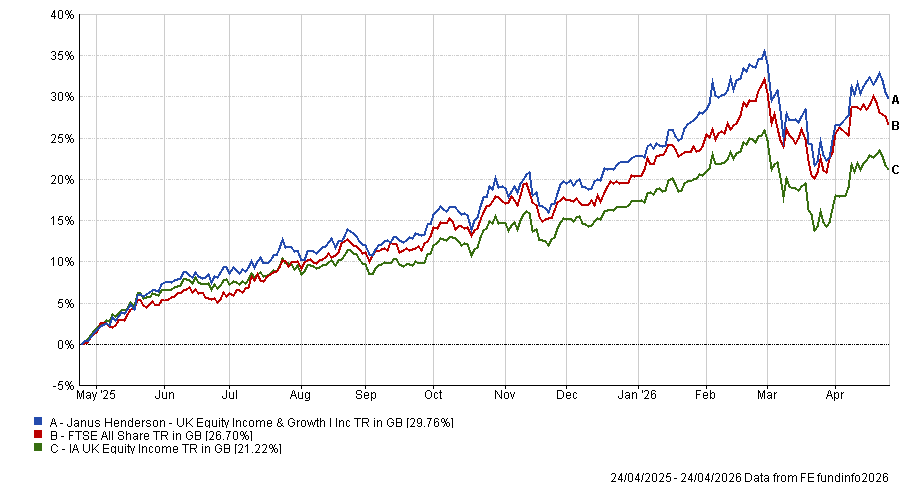
Source: FE Analytics
There are also some new entrants to the amber list. The Janus Henderson Cautious Managed, Global Select, European Selected Opportunities, Japan Opportunities and UK Smaller Companies funds were not flagged last year but have now been placed under review.
At the same time, a handful of funds have dropped off the list. Asian Dividend Income, Global Equity Income, Global Technology Leaders, UK Responsible Income and US Growth are no longer flagged.
A number of funds are in the process of being wound down due to size or redemptions, while others have undergone strategy, benchmark or fee changes.
Pat Shea, independent chair of Janus Henderson Fund Management UK, said returns improved across most asset classes in 2025 but the market backdrop remained difficult for active managers.
“Market concentration continued, with the very largest companies driving returns and the broader market tending to lag,” he said. “This backdrop proved challenging for active fund managers across the industry, in part due to risk management and diversification considerations.”