






Capital Gearing Trust is proposing a 10-for-1 share split while cutting its annual dividend by 35%.
The board has recommended a final dividend of 66p per share for the year ended 31 March 2026, down from 102p the previous year. At the same time, it is asking shareholders to approve a subdivision of the trust's ordinary shares, which would reduce the price from around £50 to approximately £5. Dealings in the new shares are expected to begin on 23 July 2026, subject to approval at the annual general meeting.
The share split is designed to lower the barrier to entry for smaller investors, monthly savers and dividend reinvestment programmes – groups the board says have been disadvantaged by a share price that has risen sharply since the trust's launch.
As for the dividend cut, the board pays out broadly what the trust earns in dividends and interest, and income fell in the year to March 2026. Of the 66p total, 43p is designated as an interest distribution and 23p as a dividend – a structure the trust uses to take advantage of UK interest streaming rules, which reduce its corporation tax liability when income comes from interest-bearing assets.
The trust delivered a net asset value (NAV) return of 5.8% over the year, against Consumer Price Index (CPI) inflation of 3.3% – a real return of 2.5 percentage points. The share price returned 6.4%. Over 10 years, the NAV total return stands at 68.6%, against CPI of 40.7% over the same period.
Performance of fund against index and sector over 1yr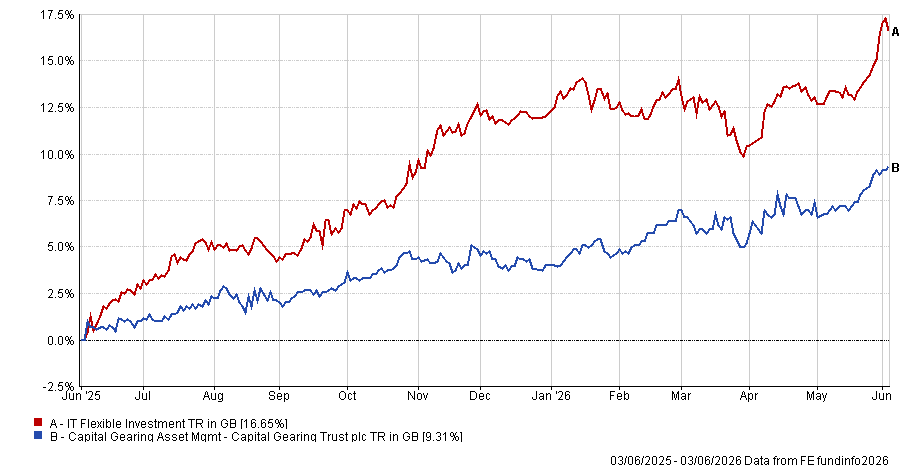
Source: FE Analytics
The 12-month period ending in March opened with US tariff announcements and closed with the outbreak of war between the US, Israel and Iran. In the sell-off that followed the tariff shock, the MSCI World Index fell 18% from peak to trough; Capital Gearing's NAV fell 2%. When the Iran conflict began, global equities fell 7%; the trust’s NAV again fell around 2%.
The trust's resilience in both episodes reflects its large allocation to inflation-linked bonds, which stood at 46% of the portfolio at the year end, split between US Treasury Inflation-Protected Securities (25%) and inflation-linked gilts (21%). The managers sold all of the trust's gold in February at $5,105 per ounce, ahead of a 17% fall in the gold price following the start of the Middle East conflict.
Equities contributed 2.3 percentage points to the gross return, the largest single component. Among the trust's investment trust holdings, Blackrock Energy & Resource Income Trust returned 73%, Fidelity Emerging Markets 61% and Monks 32%. Finsbury Growth & Income Trust fell 16% and Mobius Investment Trust fell 12%. North Atlantic Smaller Companies, the largest equity holding, returned -4%; the board says it is engaging with the company on corporate governance.
The share split, if approved, will not affect the value of existing holdings. A shareholder with one share at 4,985p would hold ten shares at a theoretical 498.5p each immediately after the subdivision.
Ongoing charges rose marginally, from 0.56% to 0.59%, as buybacks shrank the asset base. The trust repurchased 2,272,529 shares during the year at a total cost of £111.2m – fewer than the 4,067,965 bought back the previous year for £194.5m. The average discount over the year was 2%, and the shares ended March at a 2.3% discount to NAV.