






While active US and global equity funds broadly beat their benchmarks in July, emerging markets managers did the opposite: most active funds fell behind the index, even though this asset class is traditionally viewed as an area where stockpicking pays off most.
In a previous article, Trustnet revealed that 52.1% of active equity funds beat their sector's most-common benchmark in July, when markets were selling off over concerns about the AI trade. Over the 12 months prior, just 31.6% of active funds outperformed the market.
The IA Global and IA North America sectors – both peer groups where active managers have traditionally found it hard to outperform – were among those with the biggest jumps in active funds beating the market.
But emerging markets went the other way. While 61.2% of active IA Global Emerging Markets funds had outpaced the MSCI Emerging Markets index in the 12 months before July, only 35.8% did in July's sell-off.
A similar pattern was seen in IA Asia Pacific Excluding Japan, where the outperformance rate dropped from 52.8% to 40.4%, and IA Asia Pacific Including Japan, where it fell from 50% to 33.3%.
% of funds outperforming their sector's most-common benchmark
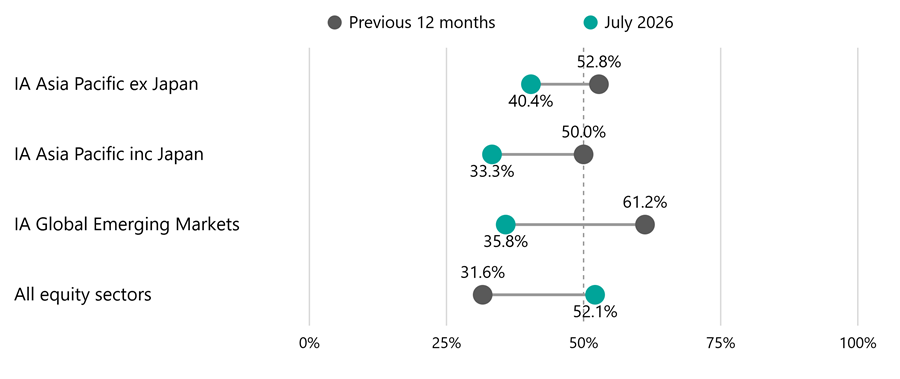
Source: FE Analytics. Average return in sterling.
Alex Paget, a manager on the Downing Fox fund-of-funds range, said the split comes down to one thing: the increasingly concentrated nature of emerging markets.
"When people talk about index concentration they tend to think of the US first, but emerging markets have actually been the more concentrated corner of the market: TSMC, SK Hynix and Samsung alone have driven the overwhelming majority of the index's return," Paget said.
Korean equities are a large part of that concentration, rallying on the booming AI semiconductor and memory chip trade, corporate governance reforms and heavy, sometimes leveraged, domestic buying.
"It was, in short, a nightmare backdrop for anyone trying to run a genuinely diversified emerging market portfolio," Paget said.
That backdrop explains why diversified managers struggled. Beating an index dominated by a handful of tech names and Korea meant holding even more of both than the benchmark itself, the opposite of what a diversified strategy is built to do.
While some managers outperformed on the upside when Korean and Asian tech was rallying hard, they suffered when Korea was at the centre of July's sell-off.
"The 'sensible', diversified managers were the ones bleeding relative performance and, in all likelihood, assets and patience along with it," Paget said.
"It increasingly looks like the average emerging market active fund has been managing relative risk (not lagging the index) rather than absolute risk (not losing clients' money), which is a polite way of saying a lot of them ended up chasing the very trade that then reversed on them."
Paget pointed to figures showing that technology and Korea exposure falls steadily when emerging market funds are ranked by performance quartile in July, from worst to best. The best-performing quartile ran roughly a third less technology exposure and half as much Korea exposure than the worst-performing quartile.
The IA Global Emerging Markets sector's best-performing funds in July were Guinness Emerging Markets Equity Income, Invesco FTSE Emerging Markets High Dividend Low Volatility UCITS ETF, iShares EM Dividend UCITS ETF and State Street SPDR S&P Emerging Markets Dividend Aristocrats UCITS ETF, all of which were up more than 5% while the index and sector lost money.
These funds have a value approach, so they are less likely to buy into expensive areas of the market after a strong bull run. They also seek out income-paying stocks, which means they have less exposure to high-growth tech names than most of the sector.
Downing Fox holds three emerging funds: Skerryvore Global Emerging Markets, Merlin Fidelis Emerging Markets and NB Emerging Markets Equity.
"They've looked pedestrian for much of this year while AI and Korea did the driving, but all three beat the emerging markets index and delivered a positive return in July, which is precisely the point of diversification: it looks dull right up until the moment it doesn't," Paget said.