






Financial advice firms hoping to attract a younger demographic of client need to invest in younger advisers and focus more on sustainability, a new report has found.
Natixis Investment Managers’ 2026 Finance Advisers survey found that almost two-thirds of advice clients are aged 45 or older (Generation X and Baby Boomers), with just 11% coming from those under 29 years old (Generation Z).
“Today, younger clients appear to be under-represented in adviser practices,” the report said, noting that this issue is becoming increasingly problematic as the Baby Boomer generation ages and starts to pass down wealth to younger generations.
“This shortage of younger clients to feed the new business pipeline is endemic in countries like the US and Australia, where the elderly population is expanding at a much higher rate than the younger population,” the report found.
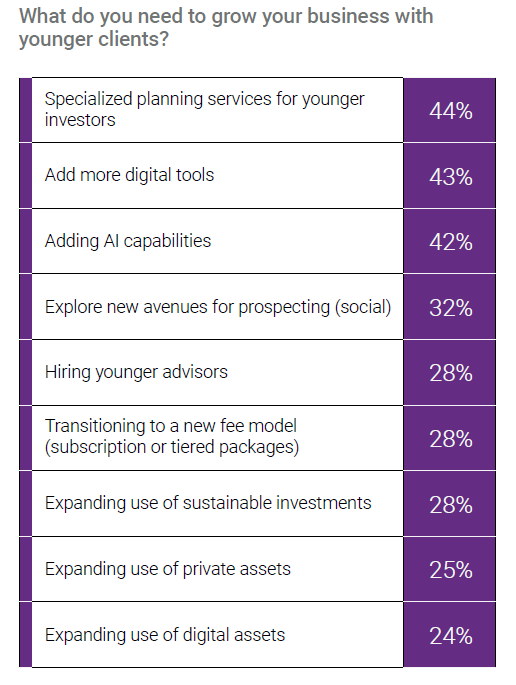
It stated that advisers are becoming more digitally savvy to attract Gen Z and Millennial clients, with firms as focused on adding digital planning tools and/or automated advice options as they are on enhancing their AI capabilities.
Additionally, around a third of respondents are “beginning to explore social media as a new avenue for prospecting”.
Source: The Natixis 2026 Finance Adviser survey
Around two in five advisers acknowledged they needed to offer specialised planning services for younger clients, such as first-time investor education, strategies for getting on the property ladder, pension-gap planning, student debt management, income management for entrepreneurs or education in specific areas of interest, such as private assets.
Also on the list were using new investment strategies, with advisers suggesting that integrating private assets, cryptocurrencies and environmental, social and governance (ESG) portfolios will also attract a younger audience.
Lastly, hiring younger advisers could tip the balance and help to attract new clients. Around 28% believe this will help, far lower than some others on the list.
“Whether it does or doesn’t, advisers may want to focus on this because it may help address another potential business disruption: an ageing adviser base,” the report noted.
Attracting a younger generation of client was one of several challenges highlighted by advisers in the survey. An ageing adviser base is another, with the report noting that 51% of respondents said they were struggling to hire younger advisers to replace those exiting the industry.
Digitalisation is a two-pronged issue, the report found. On the one hand, advisers must capitalise on using AI or risk being left behind by their competitors. While the technology can drive innovation and three-quarters said it is already freeing up time for client meetings, it also poses challenges, such as taking the competition from robo-advisers a step further.
In 2025, around half of millennials said they preferred digital advice over traditional person-to-person models, as did about 40% of Gen Xers, the report said.
“In 2026, the competitive threat has come into focus thanks to ubiquitous AI tools like ChatGPT, Gemini and Copilot,” it said. This has led to a reframing of the competition, with most advisers now viewing these large language models as their chief competitors.
Despite this, advisers are bullish on AI as an asset class, with 76% believing the trade has “a long runway for growth”, while just 21% are concerned that we are in a bubble that will burst before the end of the year.
Perhaps the biggest issue when it comes to markets is keeping clients invested, with three-quarters of advisers noting that clients are unnerved by the uncertainty and want to hold more cash.
“The key will be to remind clients that recent volatility has been short-lived and they should maintain exposure to stocks because they offer higher long-term growth potential than what they can get from ‘safe’ investments like cash,” the report said.
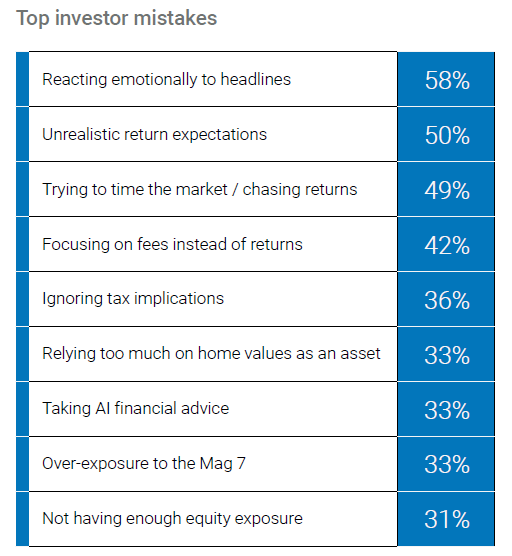
Indeed, reacting emotionally to headlines was listed as the top mistake made by investors, followed by unrealistic return expectations and trying to time the market.
Source: The Natixis 2026 Finance Adviser survey
Darren Pilbeam, head of UK sales at Natixis Investment Management, said: “Advisers are facing a number of disruptors as the industry contends with short-term challenges presented by an uncertain market, as well as larger structural shifts as a result of AI, digital competition, ageing clients and a wave of industry retirements.
“In the near term, they will need to focus efforts on reassuring investors facing uncertainty, but to succeed in the long run the number one factor for advisers will be demonstrating the value they bring that goes beyond asset allocations.”