






Looked at in a vacuum, the US market has been resilient and reliable for investors over the past year. The 16.7% returns made by the S&P 500 shows it has been another strong 12-month period, while a 9.3% gain so far in 2026 (the same amount it made in the whole of last year) means despite ongoing geopolitical issues American stocks have made progress.
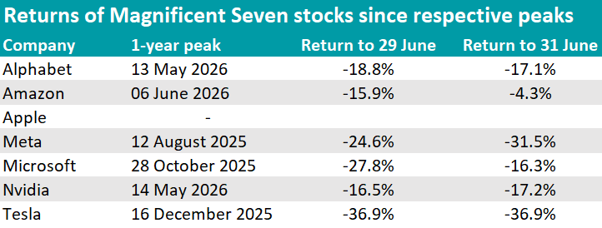
But beneath the surface there have been some stupendous losses for some of the largest US players, with six of the seven names driving the AI trade – the hyperscalers known as the ‘Magnificent Seven’ – falling by double digits from their 12-month peaks to today.
Last week Apple, Amazon, Meta and Microsoft released their earnings reports to varying degrees of success, leaving investors to question whether the AI boom is tapering off.
Source: Trustnet.
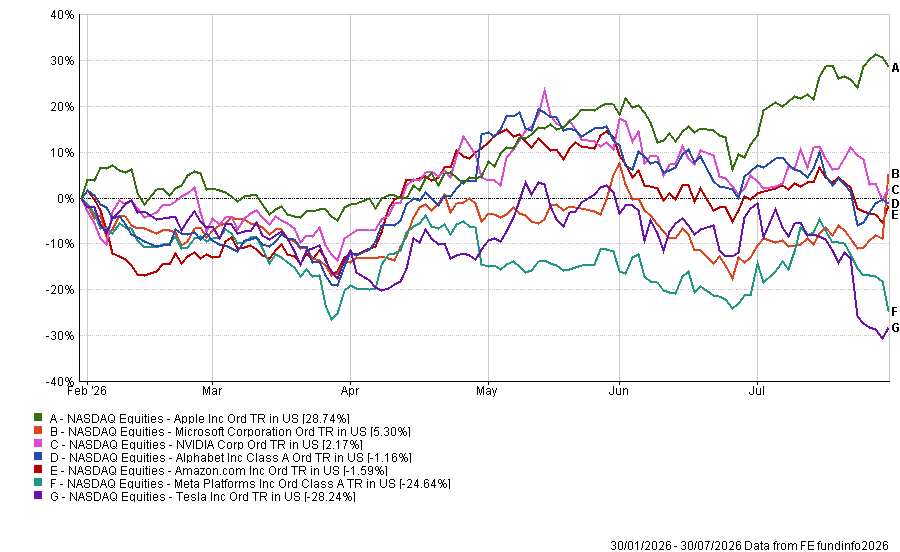
Apple has been the exception. The seventh member of the group has committed least to building its own AI infrastructure, licensing its underlying model from Google for its Siri overhaul rather than developing one in-house and has been trading at a record high, having briefly surpassed a $5tn market capitalisation and overtaken Nvidia ($4.7tn) as the world's most valuable company.
Its advantage, however, has slipped somewhat after its earnings release due to worries of a global shortage of memory chips, which Tim Cook warned would hit sales and profit in the current quarter.
It’s yet to be seen whether this will be Apple’s peak but meanwhile, the other six Magnificent Seven members have lost the equivalent of $4.6trn since their respective peaks – 98% of all stock market listed companies in the UK, as Brian Dennehy, managing director at FundExpert, noted.
“[Tesla’s] $670bn loss in its market value is equivalent to the combined valuations of Toyota + BYD + General Motors + Hyundai + Ferrari + Ford + Mercedes-Benz. Crazy,” he said.
He also noted SpaceX alone has lost $1.1trn of market value and since their peaks, Bitcoin and Ethereum have lost $1.7trn in market value.
He continued: “Few are talking about this damage and its scale because they have moved to place their bets on a different roulette table – the investor mania is alive and kicking.”
Performance of stocks over six months
 Source: FE Analytics
Some questions remain open
Alphabet said in June it would sell $80bn of stock to help fund its AI investment, having already raised $32bn in February through a 100-year bond. Alongside Amazon, Meta, Microsoft and Oracle, it is expected to spend around $800bn this year on data centres, chips and AI infrastructure.
For some, these huge sums can add up. Matt Britzman, senior equity analyst at Hargreaves Lansdown, called Amazon’s recent earnings “the clearest evidence yet” that heavy AI investment can pay off. Others are more cautious.
Cormac Weldon, head of US equities at Artemis, noted how these companies are becoming capital-intensive.
“But are they using capital efficiently? What happens if they can't monetise their AI output?” he asked. “We don't believe in the 'AI bubble' narrative and we are bullish on the AI build out, but we don't think all these players will be winners.”
Weldon's fund sold out of Microsoft entirely in May and has cut its overall hyperscaler exposure to its lowest level in years, preferring Amazon for its cloud business and chip-making capacity. “We've got our lowest exposure to hyperscalers in a while,” he told Trustnet.
Practically, the market is debating whether the wider sector is heading for a correction, beyond single names. Ben Barringer, head of technology research at Quilter Cheviot, said it is fair to ask whether “things are beginning to go pop”, although his answer remains “no”.
This is not because he sees the Magnificent Seven as back in favour, although he conceded that cloud and advertising revenue at the hyperscalers is climbing, and so is corporate use of AI tools, suggesting the spending is starting to earn its keep.
His main reason for believing that things have not popped is that the leadership has shifted away from the Magnificent Seven toward the suppliers behind the boom – memory chip makers such as Micron and SK Hynix, equipment firms such as ASML and KLA and power chip specialists such as Infineon.
“The AI trade is clearly showing signs of maturing,” Barringer said, “with investors now more focused on earnings and revenue growth rather than capex plans.”
In a note from Goldman Sachs, technology specialist Peter Callahan told readers it has become hard to string together more than two good trading days for tech stocks. The trade, he wrote, “has not run out of stories. It may simply be running short of patience”.