






The recent rise in government bond yields reflects a mismatch between demand and supply in the global economy, not rising sovereign credit risk, but none of the routes to reversing this dynamic look close at hand.
That's the view of James Bilson, fixed income strategist at Schroders, who said three market signals point away from a fiscal explanation for higher yields: short-dated US treasury yields rising faster than long-dated ones, treasuries outperforming swaps and other government bonds, and the falling cost of insuring against a US default.
This does not mean investors should be complacent about sovereign credit risk, he added. Developed markets' debt trajectories range from "the bad to the awful", but Schroders sees little evidence that this has been an issue in the recent pricing of bonds.
"Moreover, the market focus on these fiscal sustainability dynamics is highly contextual – when inflation is low or moving lower, these fears can (and will) recede. When inflation is too high or policy is tightening, they quickly resurface – as now," the strategist explained.
"In other words, fiscal fears tend to move either in virtuous or vicious circles."
Bilson said global supply capacity has been constrained by recent shocks, most severely in the Middle East, while private investment demand is unusually strong. He linked that demand to large-scale AI infrastructure spending and a parallel boom in defence and energy-related 'old economy' capital expenditure.
He argued that the root cause of the current weakness in bonds can be boiled down to one factor: combined fiscal and monetary policy is too loose to sustainably deliver 2% inflation, especially in the US.
"We think this combination of policy is crucial – what matters is not monetary policy in isolation, but how fiscal and monetary policy are interacting. If fiscal policy was withdrawing demand from the economy, monetary policy would be more than tight enough to hit inflation remits. But it's not, so it's not," he said.
"To our eyes, this explains the real importance of fiscal policy in the recent rise in yields: less about sovereign credit risk and more about creating too much demand for the economy to cope with. The net result is above-target inflation. Without fiscal restraint, tighter monetary policy must be the balancing factor. It's the release valve."
Ways to end the bond sell-off
Source: Schroders
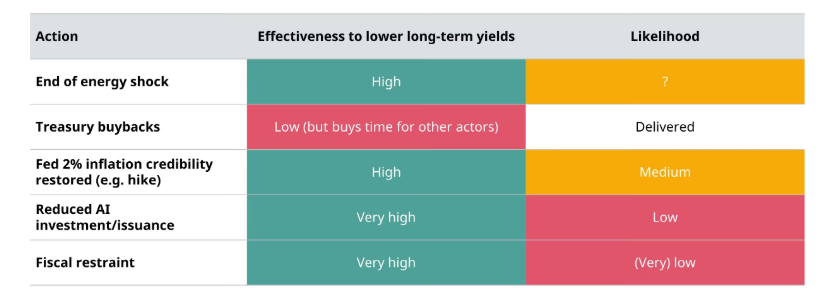
The first route to easing that imbalance, Bilson said, would be a resolution to the conflict in the Middle East, which began in February 2026. Weaker energy disruption would raise the level of growth the economy can sustain without adding to price pressure, reducing how much policy tightening is needed elsewhere.
A second route is through the Federal Reserve. Underlying US inflation remains moderately above target even without the energy shock and the strategist pointed to swings already in Fed chair Kevin Warsh's credibility on the issue: an initial gain at his first press conference, a reversal at his second and a partial recovery following hawkish remarks at the Jackson Hole forum in August 2026.
Genuine support for bonds would come from the Fed actually tightening policy, not merely sounding tougher on inflation. Bilson expected a limited "adjustment cycle" of two to three rate rises would be enough, given contained wage growth and stable inflation expectations.
Tighter short-term policy would raise yields on bonds maturing within five years but could still support longer-dated debt through a flattening of the yield curve, Bilson said. "The greatest threat to long-dated bonds is not tighter short-term policy, it is a Fed that appears uncaring about higher inflation," he noted, adding that a rate rise in September is, at the time of writing, a close call but marginally more likely than not.
A third route would come from private investment demand itself weakening, particularly AI infrastructure spending. This would ease the pressure on supply and take weight off long-dated yields.
But Bilson sees no evidence of this in recent earnings outlooks from AI-related companies, and rated a sharp near-term pullback as unlikely. "We'd consider this a high-impact, low-probability event," he said.
The fourth and, in Bilson's view, most direct route is tighter fiscal policy through spending cuts, tax increases or a mix of both. He said the right mix differs by country, but the overall direction of policy matters more than which lever is used.
However, the appetite for fiscal restraint currently looks limited. "If the US Treasury want sustainably lower yields, they should reduce deficits," he said, noting that Japan is moving towards fiscal stimulus and Germany eased its own stance last year.
Two other measures are sometimes floated as fixes, Bilson said, but he does not view either as a genuine solution. The US Treasury's recent buybacks of longer-dated debt, and any shift to more short-dated issuance, amount to a temporary fix rather than a solution.
"This is, to us, simply a buying time strategy," he said.
A Fed move towards yield curve control would be more drastic still, and Bilson rated it as carrying very low probability within the current investment horizon. He called it a "nuclear option", saying it would suppress long-end yields while expanding monetary growth, adding to demand rather than reducing it.
"We rule nothing out in these volatile times, but would put very low probability of this type of intervention within our investment horizon," he added.