






Japan has spent a decade shaking off cross-shareholdings, idle cash and management teams with little interest in shareholders. That process, started by Shinzo Abe, has picked up pace under current prime minister Sanae Takaichi.
A weaker yen, inflation that has stayed above the Bank of Japan's target for most of the past four years and a market that still looks cheap next to its global peers, means the case for Japan is building again.
Adding Japan to portfolios was positive during Abenomics, as recently revealed by Trustnet's 10-year study of Japan allocations. And there are signs that the market could be on its way back, with the Nikkei 225 the top-performing major market so far in 2026, up 29.9%, some 10 percentage points ahead of the MSCI Emerging Markets in second place and double the MSCI World’s 13.3% return.
For those who believe today might be a repeat of that era, below, Trustnet asked fund selectors which funds they would back to play it.
Darius McDermott, managing director at FundCalibre, said a permanent allocation to Japan deserves a place in most medium-to-high-risk portfolios. Investors can then tweak it depending on whether the market looks cheap or expensive. “It's a market where genuine stock pickers can add real value,” he said.
One of his picks was the JK Japan fund, which is managed by FE fundinfo Alpha Manager Simon Jones, who runs it with a style-agnostic process designed to work whether value or growth is in favour.
“Sentiment towards investment styles can swing wildly in Japan – value and growth take turns falling out of favour – so we like that Jones runs a style-agnostic, blended process rather than betting on one style holding up,” McDermott said. “A tracker is powerless to volatility in style swings.”
This agnostic approach has paid off recently. JK Japan returned 107% over three years and 153.9% over five years, with a 43.1% gain over the past 12 months alone, well ahead of McDermott’s second pick below.
Performance of fund vs sector and index over 5yrs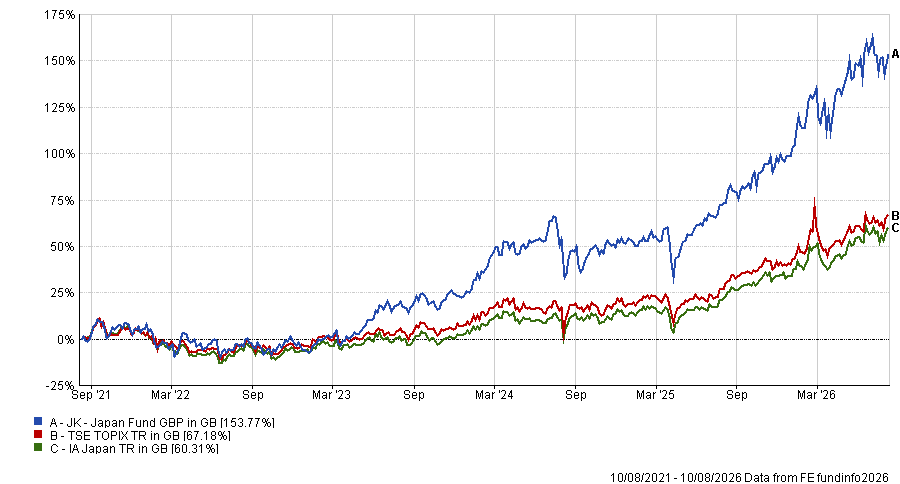
Source: FE Analytics
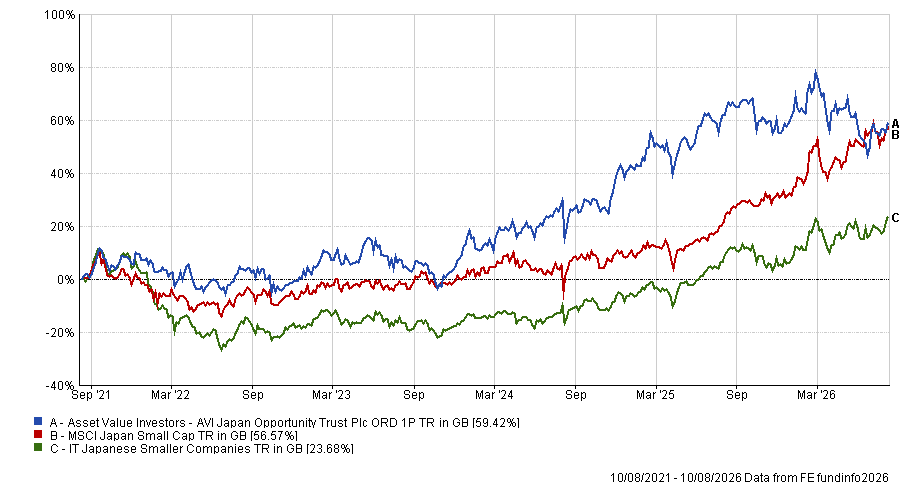
His other selection was the AVI Japan Opportunity trust, which McDermott noted took a different route to Japanese equities.
It is a small- and mid-cap portfolio focused on companies trading below their intrinsic value that is managed by Joe Bauernfreund, who engages directly with company management.
This is “an extra lever for unlocking shareholder value that isn't available to the index or most other funds,” McDermott said. “As manager Joe Bauernfreund puts it: ‘Hope is not an investment strategy.’”
The £376m portfolio has returned 44.1% over three years and 55.7% over half a decade, although the short term has been tougher, with the trust down 4.7% over 12 months and 5.7% over the six months to July.
Its portfolio is concentrated in telecoms, media and technology (32%) and industrials (26%), with almost no exposure to financials. The ongoing charges figure (OCF) is 1.56%.
Performance of trust vs sector and index over 5yrs
Source: FE Analytics
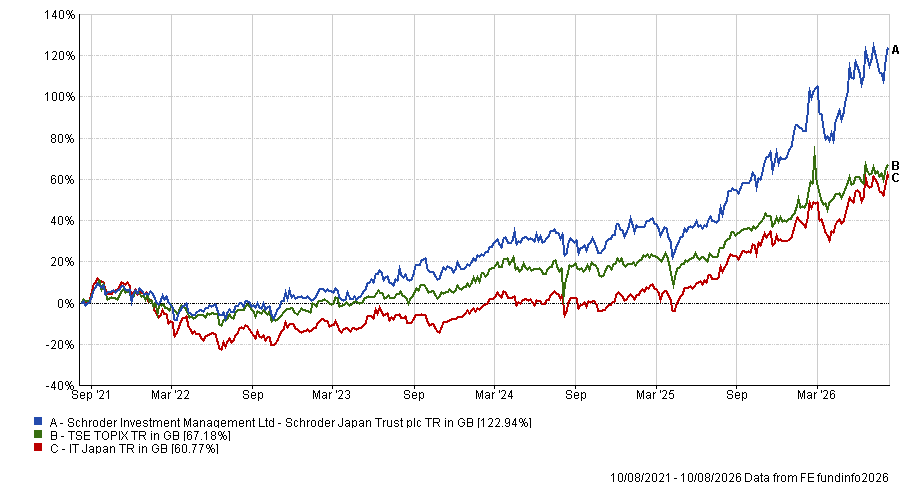
Hassan Raza, portfolio manager at CGAM, stuck with investment companies and picked the Schroder Japan Trust, a £473.6m vehicle again with a mid-cap bias, as well as an underweight to banks and semiconductors.
Despite that underweight, manager Masaki Taketsume has outperformed the TOPIX over one, three, five and 10 years, Raza noted.
From October, the Tokyo Stock Exchange will cut the number of companies in the primary TOPIX index from 1,700 to 1,100 – which Raza expects to improve liquidity and add further pressure on companies to raise their price-to-book ratios.
“As the focus of reforms shifts to smaller companies, we believe the manager's mid-cap focus is well placed to benefit,” he said.
The trust has the strongest returns of the three funds and trusts compared here over 12 months, up 48.9%. This has boosted its medium-term figures too, up 82.9% and 112.8% over three and five years respectively. Volatility has also been the highest of the three, at 28.2% over one year. The ongoing charge is 0.92% and the trust yields 3.1%.
Performance of trust vs sector and index over 5yrs
Source: FE Analytics
Away from trusts, Ben Yearsley, director at Fairview Investing, said one question investors need to answer, however, is whether to hedge the currency exposure, a decision they rarely face with other equity markets. At some point, he said, the yen will turn, which would benefit domestic Japan.
His pick is Sumitomo Mitsui Japan Equity High Conviction, a concentrated portfolio of around 30 holdings that blends value and growth.
“It’s a core holding looking to have elements of value and growth. That way you don’t need to hold two funds,” Yearsley said.
The fund uses what it calls “micro leading indicators” tied to companies' near-term earnings, alongside a filter that excludes the bottom 20% of stocks measured by an environmental, social and governance (ESG) criteria.
Its largest holdings are Mitsubishi UFJ Financial Group (7.5%), SoftBank Group (7.3%) and Sony Group (6.1%), with industrials the largest sector weighting at 27.5%.
Yearsley said conditions in Japan are starting to resemble the early Abenomics years again, “but not such a blunderbuss approach”. Cross-shareholdings continue to fall, companies are becoming more shareholder-friendly and hostile takeover activity has emerged, he said, adding that rising inflation and rates support the outlook too.