






The past year has been awash with headlines touting both record highs and sharp sell-offs in emerging market equities. In the past 100 days alone, we have seen price swings in the MSCI Asia Pacific at their highest level since the global financial crisis.
These dramatic fluctuations point to two broader market truths. First, that AI and data centre investment is now the distinguishing driver of outperformance. Second, that, because of this, emerging markets are increasingly focused on a narrow opportunity set and offering fewer diversification benefits than investors expect.
With the Magnificent Seven making up over 30% of total S&P 500 market capitalisation, many global investors are looking beyond the US to diversify their portfolios. Ironically, however, a handful of tech stocks are increasingly driving emerging market indices.
TSMC, the world’s leading semiconductor manufacturer, plays a critical role in producing the chips powering US hyperscalers, while SK Hynix and Samsung Electronics dominate the manufacturing of memory chips that are essential to AI computing infrastructure.
Together, this cohort forms part of a tightly interconnected ecosystem whose fortunes are closely linked to the trajectory of AI adoption and data centre expansion.
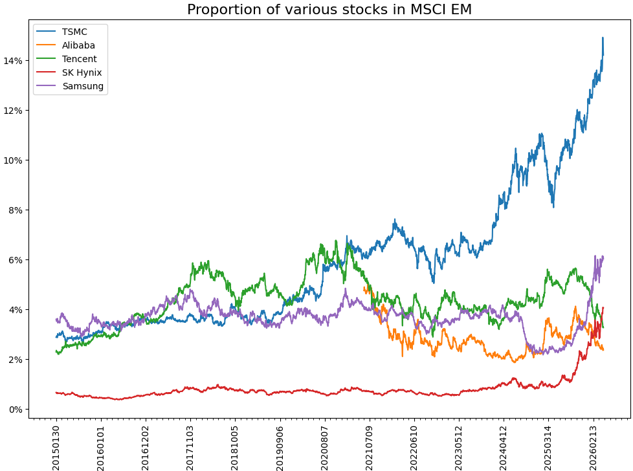
Alongside Alibaba and Tencent, these three names now account for around 35% of the benchmark, up from just 18% at the end of 2023. Within this group, TSMC alone represents close to 15% of the entire index, a significant jump from 6% at the end of 2023.
Their collective dominance goes beyond just individual stock weights; it creates exposure to the same underlying economic driver, namely the AI investment cycle.
As such, what for many investors may appear to be diversification across multiple stocks within emerging markets may, in actuality, represent a single, highly concentrated exposure.
Source: RQI Investors
This risk is striking given the MSCI Emerging Markets index contains roughly 1,200 names. Recent success has been driven by strong price performance combined with significant upgrades to earnings expectations, particularly for semiconductor names like SK Hynix and Samsung Electronics.
From the end of September 2025 to the end of June 2026, both companies have benefitted from surging demand for memory chips, delivering exceptional returns (SK Hynix up 638% and Samsung Electronics up 296%).
While some of that momentum reversed over July 2026, with SK Hynix losing 35% and Samsung Electronics down 10%, both companies have since seen a slight correction as of mid-August.
In addition, although their recent record profits have missed market forecasts, overall, upgrades to their earnings forecasts have risen faster than share prices over the medium term.
This has created an unusual dynamic. Despite strong returns, forward price-to-earnings (P/E) multiples for these companies have declined, making these stocks look cheap on a forward-looking basis. But looks can be misleading.
Semiconductor businesses have enjoyed phenomenal growth in recent years fuelled by AI enthusiasm. This demand, coupled with capacity constraints, has caused profits to surge and made valuations appear cheap.
Ultimately, these remain cyclical businesses and current growth is not sustainable over the long term, as the past month’s volatility has shown all too well.
Markets attempt to compensate for this cyclicality by focusing on what a company is expected to earn over time. This has the unintended consequence that a low P/E ratio may say more about where a company is in its earnings cycle rather than its true value.
As such, it is important that investors take a more holistic view of the factors that are responsible for driving underlying returns.
It is also important to understand how benchmark composition adjusts over time. Market capitalisation-weighted indices are calculated by allocating more weight to companies that have performed well previously.
Again, this can be misleading – past performance is not an indicator of future success – and the picture gets even murkier in periods of strong thematic growth and momentum-driven exposures.
A more disciplined approach to benchmark risk is to take a measured active position relative to the index, seeking to improve returns for each unit of risk taken. This allows investors to reap the rewards of companies benefiting from thematic trends while also bearing in mind cyclical dynamics and sector-specific characteristics.
Market capitalisation can fluctuate significantly based on short-term sentiment, momentum, and thematic trends. Economic size, by contrast, is a more stable measure of a company’s underlying business footprint.
By anchoring portfolio construction to the latter, we aim to achieve a more balanced and diversified exposure – one that is less influenced by transient market dynamics and concentrated themes.
Reducing concentration risk is not about excluding large or popular companies, which are often responsible for driving returns. It is about understanding how these companies are weighted within a portfolio, why they are owned and what economic exposures they bring.
It is only by taking this holistic view that investors can successfully navigate the fine and ever-changing line between minimising risk and maximising exposure to growth themes.
David Walsh is head of investments at RQI Investors. The views expressed above should not be taken as investment advice.