






There has been plenty of volatility to go around in the 2020s so far and the Asia-Pacific region is no exception.
After the Covid-19 pandemic, which opened the decade, markets like China suffered under a regulatory crackdown on its technology sector, while Japan continued laying the foundations for corporate governance reform.
In more recent months, the AI build-out has buoyed other markets like South Korea and Taiwan – although these upward trajectories are also punctuated with spates of volatility.
Against this backdrop, Trustnet continues its series identifying funds where taking more risk paid off. We have identified the most volatile strategies in the IA Asia Pacific Excluding Japan and IA Japan sectors that delivered first-quartile returns and Sharpe ratios between 2020 and the end of July 2026.
The Sharpe ratio measures a fund’s returns against the level of risk taken. Here, we used the same 2.76% risk-free rate applied across all sectors in this series, which reflects the average Bank of England base rate over the period and therefore the average opportunity cost facing the typical UK-based investor during this period.
IA Asia Pacific Excluding Japan
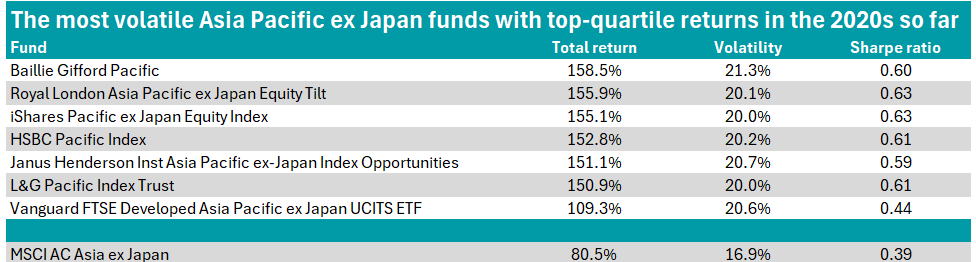
The most common benchmark utilised by funds in this sector is MSCI AC Asia ex Japan. It gained 80.5% over the assessed period, with a volatility of 16.9% and a Sharpe ratio of 0.39. It was beaten by the funds in the table below.
Source: FE Analytics
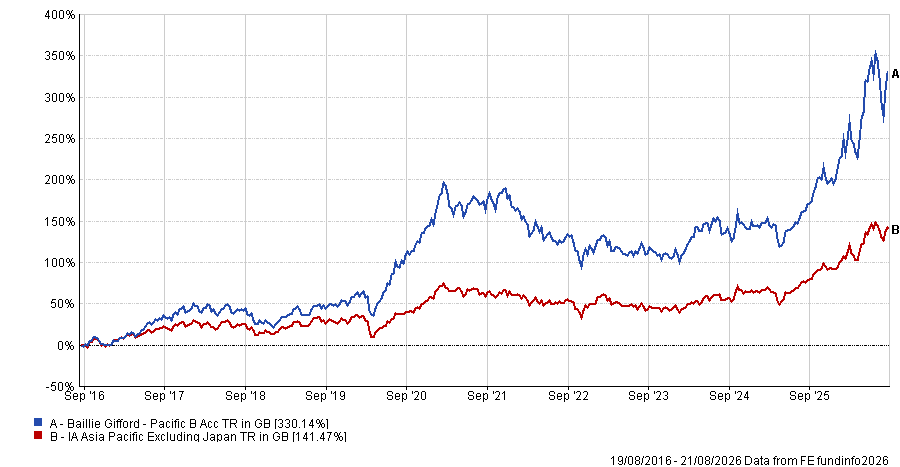
The strongest performer in the table was Baillie Gifford Pacific, which managed a Sharpe ratio of 0.60, alongside a return of 158.5% and a volatility of 21.3%. The £4.4bn strategy, launched in 2000, has an FE fundinfo Crown Rating of five and aims to outperform over rolling five‑year periods.
Co-managed by Roderick Snell and Ben Durrant, the fund is index- and sector-agnostic, focusing on long-term Asian ex Japan opportunities regardless of country or industry.
It has a 62% active share and 45% annual turnover, with significant positions in Samsung Electronics (10.4%), TSMC (9.2%) and SK Hynix (8%). Geographically, the fund is overweight China and South Korea while underweight Taiwan.
Baillie Gifford Pacific was the most bought in the sector over the first half of this year, attracting £505.8m in net new money while performance added £1.4bn.
RSMR analysts said: “Whilst the fund is managed with a growth bias, there can be different types of growth within it and the team had pulled back exposure to some of the fast-growing businesses in the internet space some years ago, so the fund has been diversified and pragmatic looking at growth drivers.”
The strategy has logged a first-quartile return in the sector over the 10 years to the end of July 2026, gaining 321.1%.
Performance of the fund vs sector over 10yrs
Source: FE Analytics
Another strong performer in the table was Royal London Asia Pacific ex Japan Equity Tilt, which returned 155.9% with a volatility of 20.1% and a Sharpe ratio of 0.63.
The £2.8bn strategy, which is co-managed by JoJo Chen and Michael Sprot, is technically active but has a more systematic overlay.
The fund is recommended by Titan Square Mile and has previously been highlighted as one of the most consistent funds in the sector since 2016, beating the MSCI AC Asia Pacific ex Japan in six of the 10 years.
Janus Henderson Inst Asia Pacific ex-Japan Index Opportunities has also outperformed despite the extra risk in the 2020s so far, with a Sharpe ratio of 0.59. Similarly to the Royal London strategy, the fund is largely passive with a small active overlay, targeting a return at least equal to the Solactive GBS Developed Markets Pacific ex Japan customised Index plus 0.5% per year, before charges, over any five-year period.
The portfolio’s top holdings are dominated by AI plays, such as TSMC, Samsung and SK Hynix.
A number of exchange-traded funds (ETFs) also appeared in the table.
Looking across the whole sector and Jupiter Asian Income logged the highest Sharpe ratio of 0.72, while Schroder Asian Income logged a Sharpe ratio of 0.69.
IA Japan
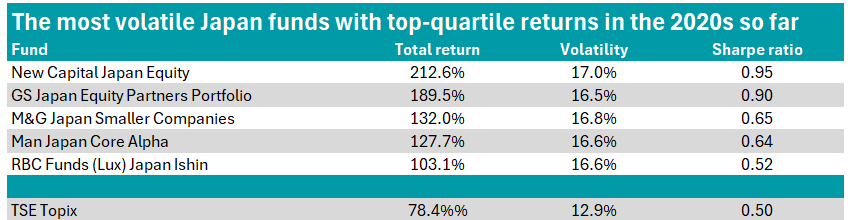
Over the assessed period, the TSE Topix index gained 78.4%, with a volatility in 12.9% and Sharpe ratio of 0.50. The funds in the table below posted stronger returns in line with the amount of risk taken.
Source: FE Analytics
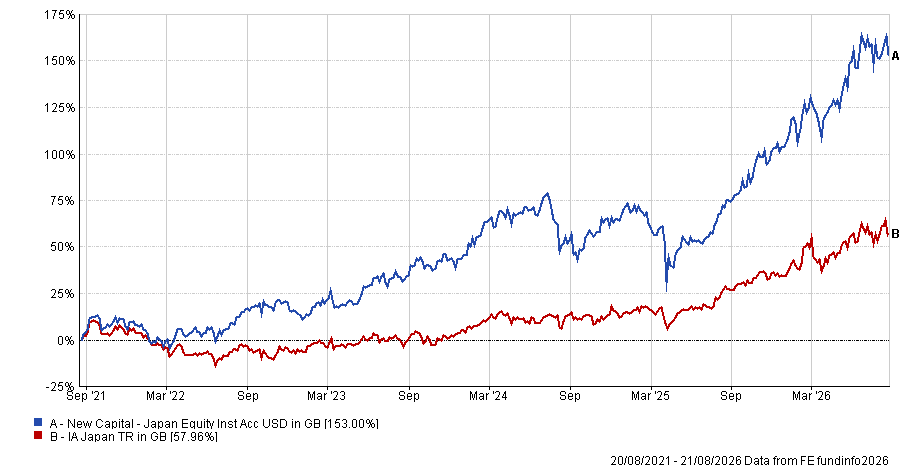
The highest Sharpe ratio in the table was logged by New Capital Japan Equity at 0.95. It delivered the strongest return in both the table and the whole sector between 2020 and July 2026, gaining 212.6%.
The fund invests in Japanese equities using a bottom‑up stock‑picking approach, aiming to exploit market inefficiencies by identifying large gaps between market prices and expected values. As such, the 60‑stock portfolio is geared toward more defensive, value-driven sectors, such as in industrials (26.6%) and financials (18.3%).
More than 90% of the fund is invested in Japanese large‑caps, including Mitsubishi, Sony and Toyota.
Launched in 2018, the strategy has logged first‑quartile returns over one, three and five years.
Performance of the fund vs sector over 5yrs
Source: FE Analytics
Another strong performer since 2020 is GS Japan Equity Partners Portfolio, which logged a 189.5% gain with a volatility of 16.5% and a Sharpe ratio of 0.90.
Managed by Ichiro Kosuge since 2015, the fund usually holds between 25 to 40 stocks the management team believes are sustainable and growing and not dependent on Japan’s economic cycle.
RSMR analysts recommended the fund, noting that it is “a high alpha specialist approach which takes a focused, concentrated approach to investing in Japan” that would work well as a satellite holding for investors wanting to balance this approach with a value offering.
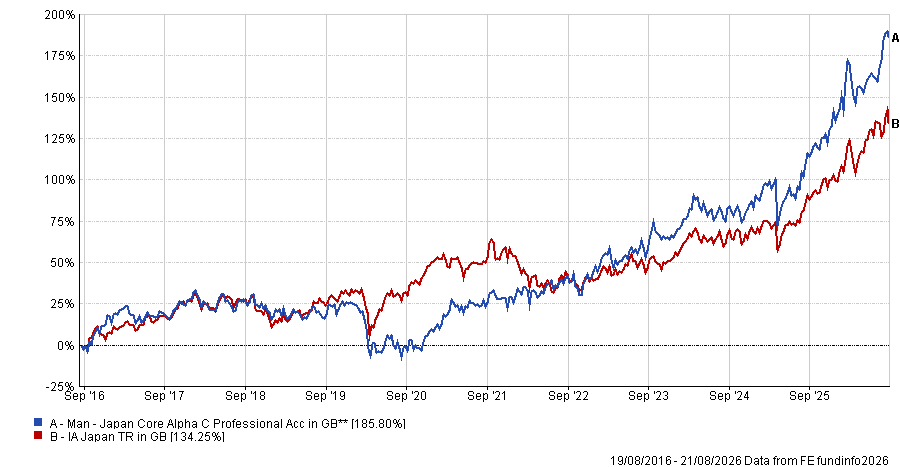
The £3.2bn Man Japan Core Alpha strategy also met the criteria, with a Sharpe ratio of 0.64.
It has been managed by Jeff Atherton since 2021, with Emily Badger as deputy manager since 2023.
Man Japan Core Alpha is recommended by Hargreaves Lansdown, Barclays and interactive investor, who note that its value bias should reward investors over the long term.
Indeed, it has proven to be a consistent outperformer, logging top‑quartile returns over one, three, five and 10 years, gaining more than 200% over the decade to the end of July 2026.
Performance of the fund vs sector over 10yrs
Source: FE Analytics
Similarly to the IA Asia Pacific excluding Japan sector, the funds in the IA Japan sector with the highest Sharpe ratio were also among those that proved less volatile.
Nomura Japan Strategic Value was in the third quartile for volatility and logged a Sharpe ratio of 1.09 and a 226.1% return. This represents both the strongest return and Sharpe ratio in the whole sector over the assessed period.