






Few funds have generated more debate in recent years than the £11.2bn Fundsmith Equity.
Its popularity can be attributed to its easy-to-understand approach: buy good companies, do not overpay and then do nothing, said Sheridan Admans, founder of Infundly.
The result of that philosophy has been a concentrated portfolio of durable, cash-generative businesses with high returns on capital, strong competitive advantages and relatively little reliance on debt, he noted.
Manager Terry Smith’s communication style is another strength of the fund, according to Darius McDermott, managing director at FundCalibre.
He said: “Smith’s annual letters made a large fund feel personal. Investors felt they knew the manager and understood his thinking, which is something the wider industry could learn from.”
Since its launch in November 2010 to the end of August 2026, Fundsmith Equity returned 13.2% a year, beating the IA Global sector average of 9.8%.
Fund selectors agreed that Smith’s approach worked especially well during the 2010s, when central banks held interest rates at record low levels, as this enabled quality businesses to compound returns strongly, benefiting as they did both low discount rates within valuation models and low financing costs.
“It has become a default global equity holding for many UK investors, even though performance has been more difficult in recent years [as quality stocks have struggled in a growth market],” Admans said.
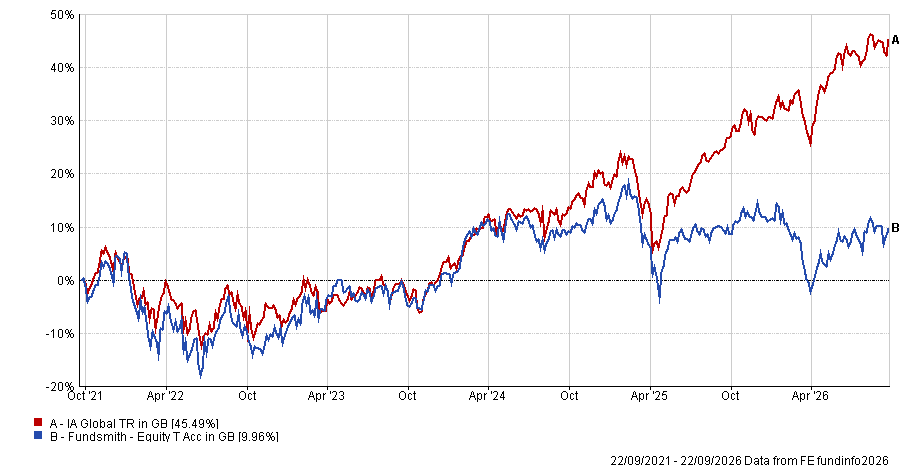
The fund has been languishing in the third or fourth quartile of the IA Global sector every year since 2022. Last year, the fund gained just 0.8% – over the five years to the end of August 2026, the fund returns 8.6%. In the first half of 2026, the fund logged £3.3bn in outflows while performance lost a further £523m.
Performance of fund vs sector over 5yrs
Source: FE Analytics
McDermott said: “While quality has struggled over the past five years, it has been a very good investment over 20, and that long-term return is why the style still deserves its places as a core building block for many portfolios.”
The recent level of interest may also reflect the changes announced earlier in the year. Its portfolio turnover exceeded 50% during the first half of 2026, initiating 12 new positions in companies including Mastercard, TSMC and Netflix, while exiting Unilever, Novo Nordisk and Nike.
The fund will now also pay greater attention to earnings momentum and, to a lesser extent, share-price momentum, when deciding whether to continue holding a company, Admans explained.
Whether Smith’s recent changes will vindicate patient holders or accelerate further departures remains to be seen. But, for investors weighing their options, Trustnet asked fund pickers which other strategies they view as credible alternatives.
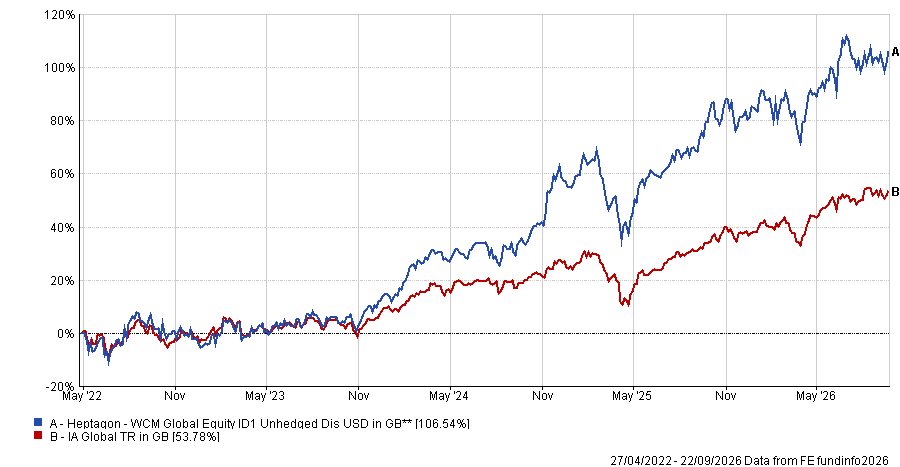
Admans suggested WCM Global Equity, which invests in a focused portfolio of high-quality businesses that it believes can compound in value over many years.
“What particularly appeals to me is WCM’s focus on whether a company’s competitive advantage is getting stronger, what it calls its ‘moat trajectory’, rather than simply whether the business already has a strong franchise,” he said.
It also examines whether the company’s culture will help management sustain that progress.
“This provides a forward-looking way of distinguishing between high-quality businesses that are improving and those whose strongest years may be behind them,” he said.
The comparison between the two funds is becoming “less clear-cut”, however, with Admans noting that Fundsmith Equity’s new emphasis on momentum and willingness to sell companies that are not delivering could make it more active and responsive than it has been historically.
“WCM Global Equity can still behave differently because its portfolio often includes companies with stronger growth expectations and exposure to areas such as digital infrastructure, electrification and industrial technology,” he said.
Performance of fund vs sector over 5yrs
Source: FE Analytics
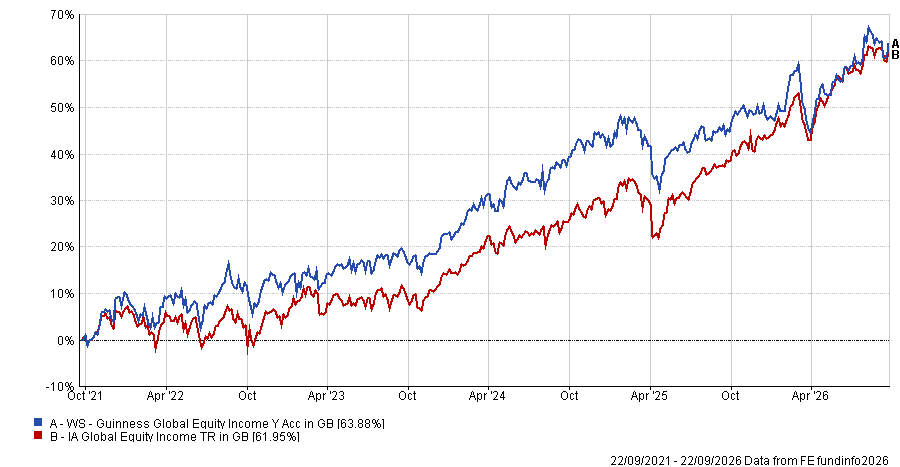
Paul Angell, head of investment research at AJ Bell, suggested the £189.7m WS Guinness Global Equity Income fund.
Unlike Fundsmith Equity, the fund has more of an income focus, with the management team placing a strong emphasis on the quality and consistency of a company’s dividend as a measure of corporate strength.
“Although the fund is categorised as an income strategy, we believe it’s best viewed as a high‑quality global core option, with the added benefit of generating an income level above the index,” said Angell.
He added that the fund – which is co-managed by Ian Mortimer and Matthew Page – has a concentration similar to that of as Fundsmith Equity, even if the managers avoid excessive stock-specific risk by equally weighting their 35 holdings.
“The Guinness team’s clear and consistent investment approach has delivered strong returns over time but with lower volatility than the wider market,” Angell said.
Performance of fund vs sector over 5yrs
Source: FE Analytics
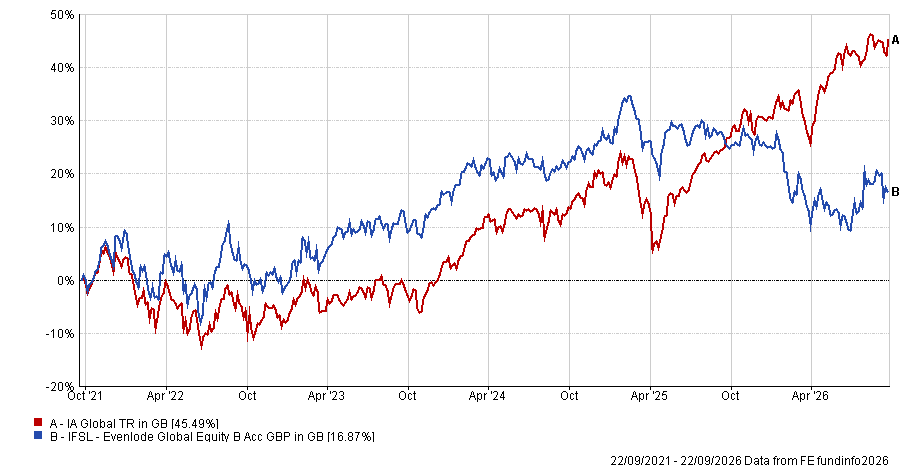
McDermott then pointed to IFSL Evenlode Global Equity, which is co-managed by Chris Elliott and Christina Dyer.
Similarly to Fundsmith, it also invests in quality, cash-generative companies with durable competitive advantages and it is concentrated and focused on compounding free cashflow.
It has had a tough spell as software sold off, but for McDermott that reflects sentiment, not weaker fundamentals.
Indeed, in a note published at the end of June 2026, the managers noted that the portfolio “stands at an interesting crossroads” with many holdings caught by the ‘AI loser’ narrative – one they do not believe will hold over the long-term.
“While we do not know when the inflection will come, or what the catalyst will be to dispel the current narrative, we do know that narratives can change on a dime,” they said.
The fund logged £410m in withdrawals in the first half of 2026, while losing £128m through performance.
Performance of fund vs sector over 5yrs
Source: FE Analytics
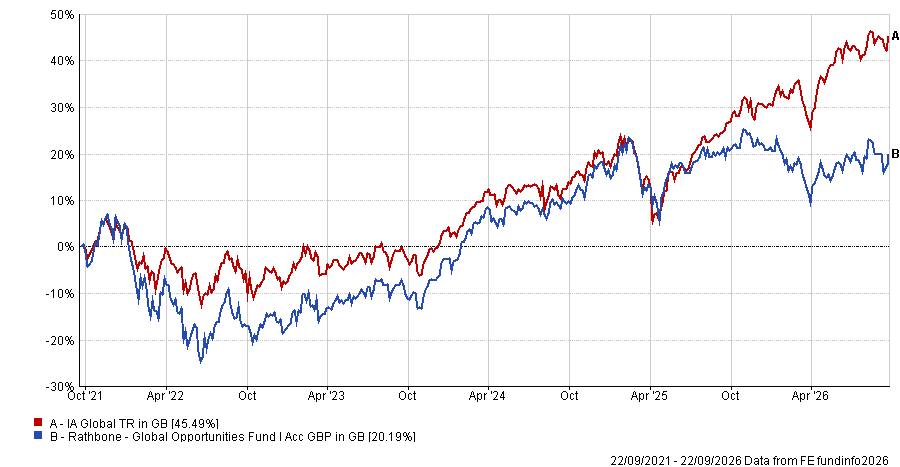
Turning to larger funds, McDermott also suggested the £3.1bn Rathbone Global Opportunities fund.
“[FE fundinfo Alpha Manager] James Thomson has run it since 2003, with one of the sector's strongest long-term records,” he said.
Thomson backs out-of-favour quality-growth companies for the long term, “giving Fundsmith Equity-style compounding with a more contrarian approach”, McDermott noted.
Top holdings in the fund – which typically holds between 50-60 stocks – include Magnificent Seven stocks Nvidia, Alphabet and Amazon, alongside more defensive holdings such as Schneider Electric.
Its approach has delivered strong returns over the 10 years to the end of August 2026, as it gained 185.2% over the decade, placing it in the second quartile of the IA Global sector.
Performance of fund vs sector over 5yrs
Source: FE Analytics