






Combining different styles and risk profiles through fund pairings can help smooth market ups and downs and boost diversification, but investors need to choose their combinations wisely.
Kate Marshall, lead investment analyst at Hargreaves Lansdown, said: “Markets can be unpredictable, moods can change and no single investment style works in all conditions. That’s why bringing together contrasting approaches can help create a more balanced and resilient portfolio.
“Pairing funds with different styles, regions and risk profiles can offer reassurance when markets are unsettled and support when conditions improve.”
With that in mind, Hargreaves Lansdown has picked four fund pairings that show how complementary approaches can play an important role in a long-term investment strategy.
Growth and value
The first pairing brings together the high-growth approach of Baillie Gifford American and the value-driven Lazard Global Equity Franchise.
Performance of fund against index and sector over 1yr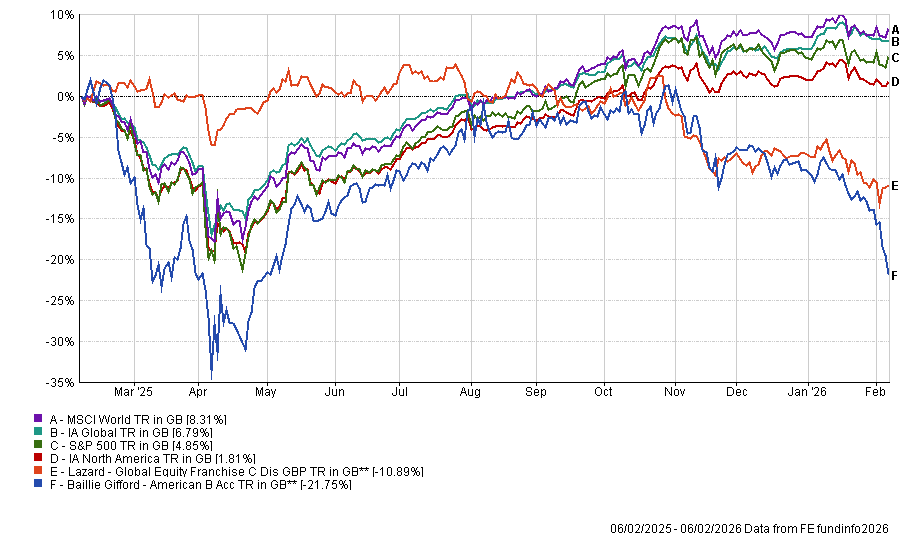
Source: FE Analytics
The former focuses on highly innovative companies and those expected to deliver strong earnings growth into the future, but can also be more volatile when sentiment shifts or expectations aren’t met.
Co-managed by Gary Robinson, FE fundinfo Alpha Manager Tom Slater, Kirsty Gibson and Dave Bujnowski, the fund has achieved a second-quartile return against the IA North America peer group, but fell to the fourth quartile over one and five years and to the third over three.
On the other hand, Lazard Global Equity Franchise portfolio buys quality companies when they are cheap and has less invested in the US than other global funds, which “can help balance portfolios across different market environments”, according to Marshall.
“While one looks for the next generation of fast-growing businesses, the other focuses on undervalued companies with more predictable earnings – a reminder that, in investing, different strengths can complement each other.”
The two have a very low three-year correlation (0.43%) to each other, meaning that historically, they haven’t gained or lost money in tandem.
Equity and bond
The second pairing combines Rathbone Global Opportunities with Invesco Tactical Bond, illustrating how different asset classes can pull in different directions at different moments.
Performance of fund against index and sector over 1yr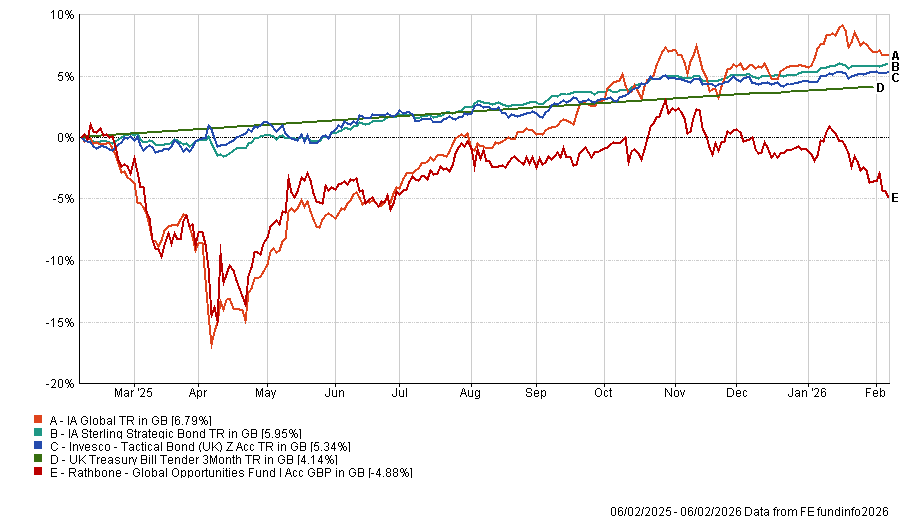
Source: FE Analytics
“While not always perfectly uncorrelated, equities and bonds can behave differently in different market conditions, including during periods of market stress,” said Marshall.
Managed by Alpha Manager James Thomson, Rathbone Global Opportunities can swing when sentiment deteriorates; for example, in the year to 31 January 2022, it fell 5.3% as global markets sold off, while it was down again in the year to January 2026, losing 3.2%.
That’s when Invesco Tactical Bond steps in. Run by Stuart Edwards and Julien Eberhardt, it sits at the other end of the risk spectrum, with a FE risk score of 40 versus 104 for Rathbone. The correlation between the two is 0.40, low enough to suggest they have moved differently through market cycles.
Core and satellite
The third combination pairs the passive Fidelity Index World fund with Jupiter India in a classic core-and-satellite, passive-and-active construction.
Fidelity Index World provides broad, low-cost exposure to developed markets and acts as a core holding. Hargreaves highlighted it for its performance, as the tracker is up 7.6% over the year, comfortably ahead of the IA Global sector’s 5.9%, as the chart below shows.
Performance of fund against index and sector over 1yr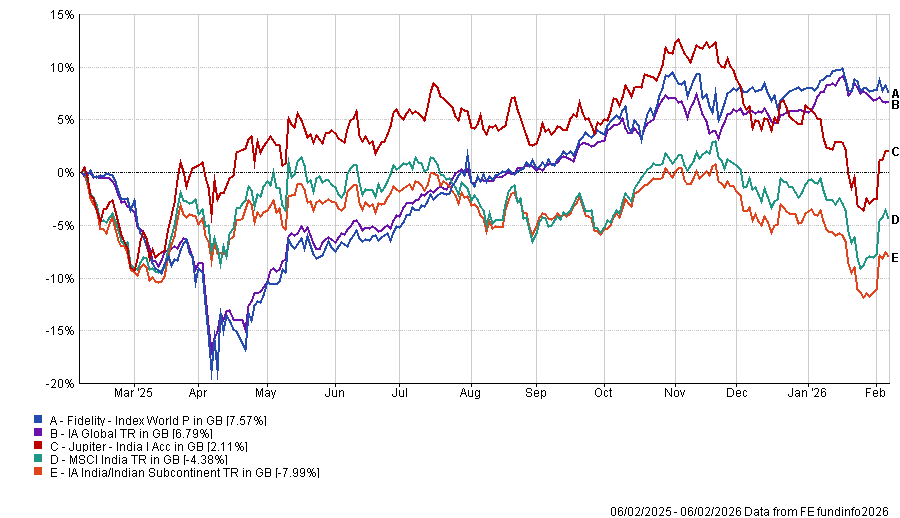
Source: FE Analytics
In contrast, Jupiter India is a concentrated, higher-risk satellite fund with variable performance: it has grown as much as 35% in a year (as it did in 2021) or fallen 20% as in 2018. More recently, it made 24.1% in 2024 and was down 0.1% last year.
The two funds have an extremely low three-year correlation of 0.09, underlining how differently they behave.
Adventurous and defensive
The final pairing brings together Artemis UK Smaller Companies and Troy Trojan, contrasting growth potential with capital preservation.
Performance of fund against index and sector over 1yr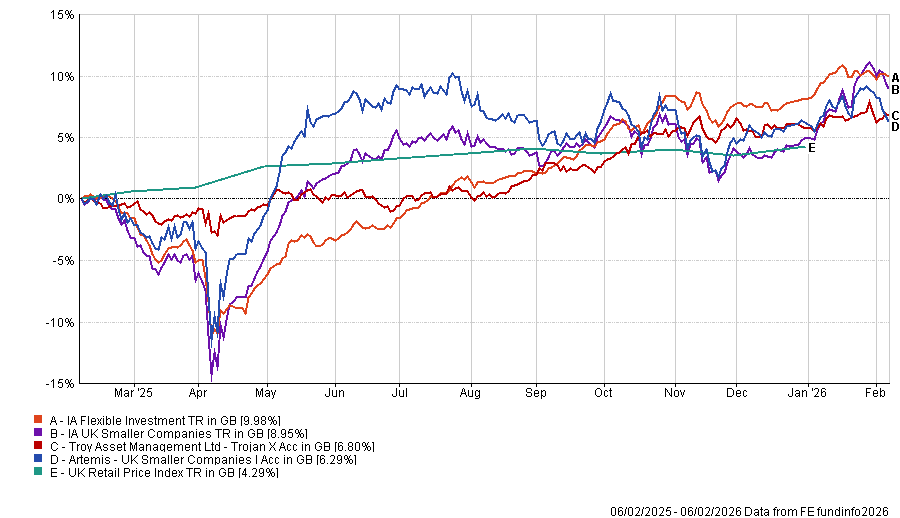
Source: FE Analytics
Focusing on smaller UK equities, the Artemis fund is more sensitive to changes in economic conditions and investor sentiment. Returns have been uneven but over the past 12 months it gained 9.3% – broadly in line with the IA UK Smaller Companies sector’s 10.3%.
Troy Trojan sits in defence. This multi-asset portfolio, managed by Alpha Manager Sebastian Lyon and Charlotte Yonge, blends equities (currently at a 42% weighting) with fixed interest (45%), gold (11%) and cash (2%), prioritising protecting investors’ money in difficult markets.
The three-year correlation between the two is effectively zero at 0.01, suggesting they have historically moved almost independently of each other.
“Blending higher-risk and defensive approaches can boost long-term growth potential while helping portfolios weather tougher periods, proving that adventure and caution can be the perfect pairing,” Marshall concluded.
| Name | Size | Sector | 5yr return | OCF |
| Artemis UK Smaller Companies | £555.9m | IA UK Smaller Companies | 46.1% | 0.86% |
| Baillie Gifford American | £2.1bn | IA North America | -20.1% | 0.52% |
| Fidelity Index World | £14.2bn | IA Global | 82.2% | 0.12% |
| Invesco Tactical Bond | £885.8m | IA Sterling Strategic Bond | 12.4% | 0.70% |
| Jupiter India | £1.6bn | IA India/Indian Subcontinent | 117.3% | 1.00% |
| Lazard Global Equity Franchise | £518.7m | IA Global | 36.3% | 0.82% |
| Rathbone Global Opportunities | £3.6bn | IA Global | 37.1% | 0.77% |
| Troy Trojan | £5.2bn | IA Flexible Investment | 31.3% | 0.86% |
Source: FE Analytics