






ISA Season Special · Part 3 of 5
Investors are looking to make the most of what they have left of their £20,000 ISA allowance before the end of the tax year on 5 April, so each week until then Trustnet is asking the UK's largest investment platforms to build model portfolios from their own best-buy lists – a ready-made starting point for investors who want a framework rather than a blank page.
This week, it is Fidelity International's turn. Investment director Tom Stevenson took a different approach from the platforms that preceded in this series: rather than prescribing fixed weightings across a set number of funds, he offered a collection of building blocks – funds that recur across investor types in different combinations – and let the balance shift depending on how much risk the end investor is willing to take.
The building blocks
Four funds appear across most or all of Stevenson's portfolios and form the core of his thinking: Fidelity Global Dividend, Dodge & Cox Global Stock, International Public Partnerships and the iShares Physical Gold ETF.
Fidelity Global Dividend, managed by FE fundinfo Alpha Manager Daniel Roberts and Tristan Purcell, appears in each of the below portfolios, from core to defensive, and its role shifts from growth engine for younger investors, income anchor for the middle-aged and resilience provider for retirees. The fund focuses on companies with high and growing cashflows and applies valuation discipline, which has produced a five-year return of 80.3% with "a relatively smooth ride".
Performance of fund against index and sector over 1yr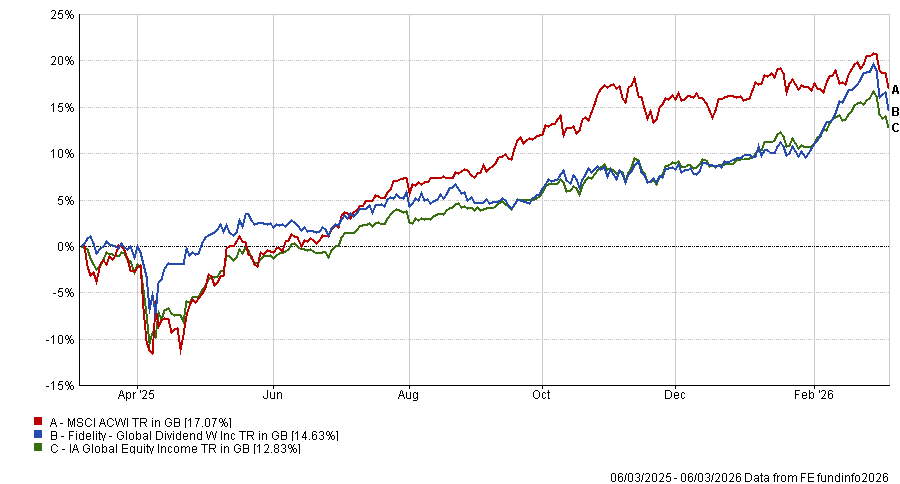
Source: FE Analytics
Dodge & Cox Worldwide Global Stock is the value complement. The San Francisco-based firm's committee-driven approach – which includes fundamental research, long holding periods and a preference for good companies at attractive prices – shows up in the five-year return of 81.6%, broadly in line with Fidelity Global Dividend but built on different underlying positions. Stevenson described it as "pragmatic", noting it will own growth stocks if they are attractively valued, which prevents it from becoming a pure style bet.
Performance of fund against index and sector over 1yr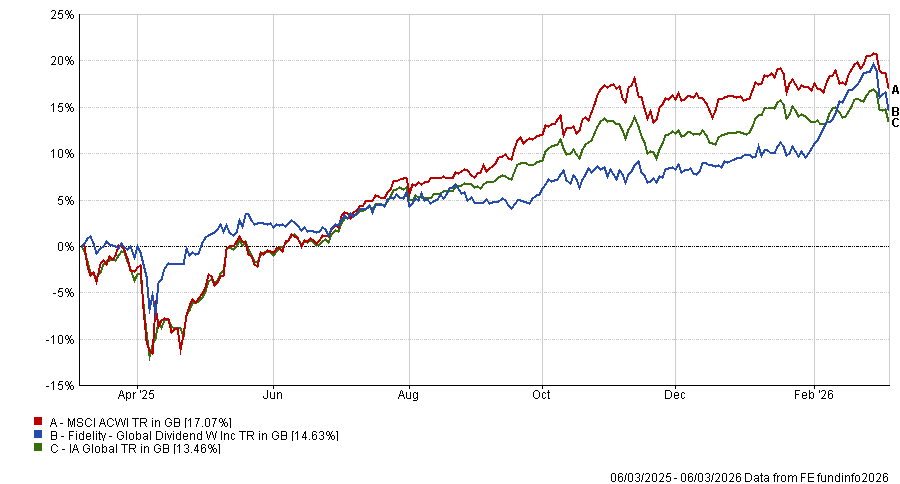
Source: FE Analytics
International Public Partnerships is the one investment trust in the mix. It provides exposure to infrastructure assets – such as roads, schools and hospitals – that generate long-term, often government-backed income streams. The trust has increased its dividend every year since 2006, though Stevenson was careful to note that income is not guaranteed. With a five-year return of just 6.7%, it is not a growth holding; it is there to dampen volatility and provide ballast, particularly in equity-heavy portfolios.
Performance of fund against index and sector over 1yr 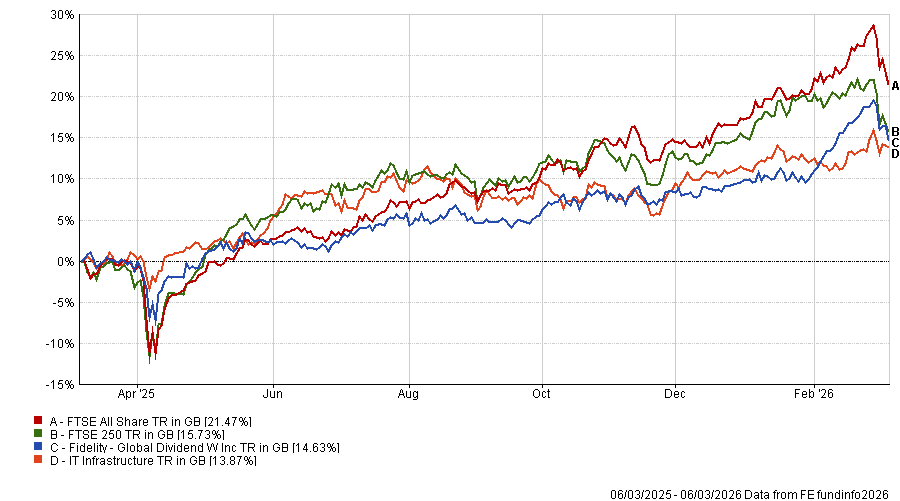
Source: FE Analytics
The iShares Physical Gold ETF rounds out the core. Gold's role here is insurance rather than return – a hedge against inflation and geopolitical uncertainty that Stevenson described as "a useful insurance policy over a 10-year period".
Performance of funds against index and sector over 1yr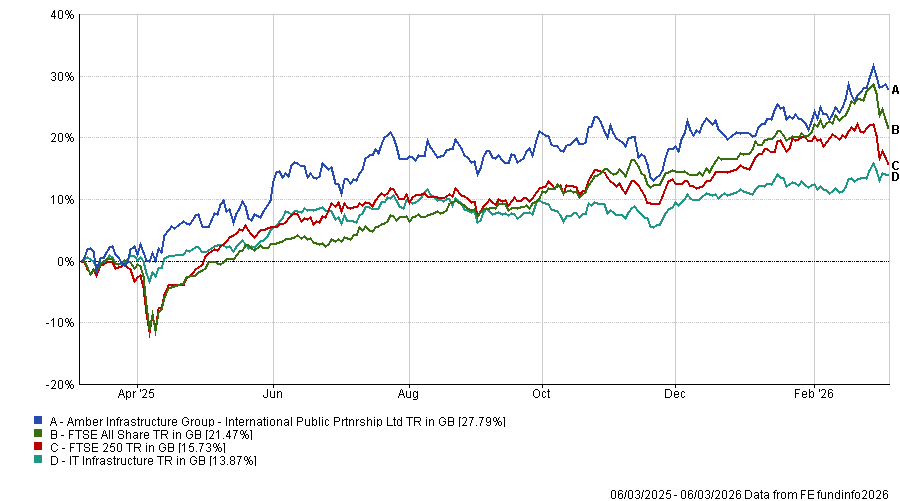
Source: FE Analytics
Core allocation
Suitable for: Investors wanting a balanced foundation that blends growth, value and diversification without tilting too heavily in any direction.
| Fund | Size | Sector | 5yr return | OCF |
| Rathbone Global Opportunities | £3.5bn | IA Global | 38.7% | 0.76% |
| Fidelity Global Dividend | £3.9bn | IA Global Equity Income | 80.3% | 0.91% |
| International Public Partnerships | £2.3bn | IT Infrastructure | 6.7% | 1.12% |
| iShares Physical Gold ETF | £216.1m | Gbl ETF Commodity & Energy | – | – |
| Fidelity Special Situations | £4.3bn | IA UK All Companies | 102.7% | 0.91% |
Source: Fidelity International, FE Analytics.
For balanced investors, Stevenson added to funds to his core portfolio. Rathbone Global Opportunities, managed by Alpha manager James Thomson and Sammy Dow, is the growth engine. The fund holds 40–60 companies the managers believe can grow faster than the broader market, a concentrated approach that has returned 38.7% over five years, lagging the value-heavy alternatives elsewhere in the table. Stevenson acknowledged the fund's growth bias "can lead to periods of volatility, as seen in 2022", but stressed it focuses on proven business models rather than speculation.
The contrarian slot goes to Fidelity Special Situations, managed by Alpha Manager Alex Wright and Jonathan Winton, which has been the standout performer in this portfolio with a five-year return of 102.7% – the best of any equity fund across the entire series. It taps into valuation opportunities in the UK market, which Stevenson noted "trades at a significant discount to the US". For a core portfolio, a UK-focused contrarian fund provides both geographic diversification and a valuation cushion that a global growth fund cannot offer.
Infrastructure and gold complete the picture, providing the non-correlated exposure that stops the portfolio from moving entirely in lockstep with global equity markets.
Growth tilt for younger investors
Suitable for: Investors with a longer time horizon and a higher tolerance for volatility, looking to tilt more heavily towards growth.
| Fund | Size | Sector | 5yr return | OCF |
| Rathbone Global Opportunities | £3.5bn | IA Global | 38.7% | 0.76% |
| Brown Advisory US Smaller Companies | £385.4m | IA North American Smaller Companies | 10.1% | 0.85% |
| Fidelity Global Technology | £24.7bn | IA Technology & Technology Innovation | 98.4% | 1.04% |
| Lazard Emerging Markets | £1.5bn | IA Global Emerging Markets | 95.9% | 1.04% |
Source: Fidelity International, FE Analytics.
The growth portfolio is the most aggressive of the four and the only one where the core building blocks – gold, infrastructure, Dodge & Cox – step aside in favour of pure equity exposure across four different growth themes.
Rathbone Global Opportunities appears again. Alongside it, Stevenson introduced Brown Advisory US Smaller Companies, managed by Christopher Berrier and George Sakellaris, to capture the smaller-cap opportunity he sees in the US.
"Given how dominant the largest US stocks have been in recent years, smaller companies may offer attractive long-term potential, with valuations typically less stretched," he said. The 10.1% five-year return reflects a difficult period for the asset class rather than a structural weakness in the strategy.
Fidelity Global Technology, managed by Hyunho Sohn, is the highest-returning fund in this portfolio at 98.4% over five years, yet Stevenson chose it for its underweight position in mega-cap US tech stocks, which offers "a differentiated way to access innovation" relative to a plain index tracker. At £24.7bn, it is by far the largest fund in the series, a reflection of how much investor interest the technology sector has attracted.
Lazard Emerging Markets, run by a four-strong team including James Donald and Rohit Chopra, rounds out the portfolio with geographic breadth. Its five-year return of 95.9% is the second-strongest in the series and reflects the fund's focus on quality companies at reasonable valuations with improving fundamentals – a disciplined approach that has paid off in a volatile asset class.
Growth and income for middle-aged investors
Suitable for: Those seeking a blend of growth and income, with capital stability becoming more important alongside continued participation in equity markets.
| Fund | Size | Sector | 5yr return | OCF |
| Fidelity Global Dividend | £3.9bn | IA Global Equity Income | 80.3% | 0.91% |
| Dodge & Cox Global Stock | £3.9bn | IA Global | 81.6% | 0.63% |
| International Public Partnerships | £2.3bn | IT Infrastructure | 6.7% | 1.12% |
| iShares Physical Gold ETF | £216.1m | Gbl ETF Commodity & Energy | - | - |
Source: Fidelity International, FE Analytics.
The income portfolio strips the portfolio back to four funds, remaining with a combination of income, value, infrastructure and gold.
Fidelity Global Dividend and Dodge & Cox sit side by side as the equity core. Roberts and Purcell at Fidelity are focused on cashflow quality and dividend sustainability while the Dodge & Cox committee is focused on valuation gaps and long-term fundamentals. Together, they cover the income-with-growth brief from two different angles.
Infrastructure and gold return in the mix. At this stage of an investor's life, Stevenson said the priority shifts from accumulation to preservation of what has already been built, and non-correlated assets become more valuable because they tend to hold up when equity markets are struggling.
Defensive tilt for PENSIONERS
Suitable for: Those seeking a blend of growth and income, with capital stability becoming more important alongside continued participation in equity markets.
Source: Fidelity International, FE Analytics.
| Fund | Size | Sector | 5yr return | OCF |
| Fidelity Global Dividend | £3.9bn | IA Global Equity Income | 80.3% | 0.91% |
| Dodge & Cox Global Stock | £3.9bn | IA Global | 81.6% | 0.63% |
| International Public Partnerships | £2.3bn | IT Infrastructure | 6.7% | 1.12% |
| iShares Physical Gold ETF | £216.1m | Gbl ETF Commodity & Energy | - | - |
The defensive portfolio is the income portfolio with the dial turned further towards stability. The fund list is identical but the emphasis shifts: Fidelity Global Dividend and infrastructure move to the foreground, with Dodge & Cox retained in a supporting role to ensure the portfolio does not lose all contact with equity market returns over time.
"Funds such as Fidelity Global Dividend, with its focus on cashflow and valuation discipline, may suit those seeking resilience," Stevenson said. Gold retains its place as a hedge against inflation and geopolitical risk – perhaps more relevant for a retiree drawing down a fixed pot than for a younger investor with decades of contributions still ahead.
The case for keeping Dodge & Cox even at this stage is that pure defensiveness carries its own risk: a portfolio with no equity growth engine can be eroded by inflation over a long retirement. A value-oriented global fund, held at a modest weight, helps balance income with what Stevenson called "long-term growth potential" without reintroducing the volatility of growth-style equities.
Previously in the series: interactive investor's and AJ Bell's perfect portfolio.
Next week: We continue with best-buy picks from our third platform ahead of the 5 April ISA deadline.