






Ramping up geopolitical tension is prompting investors to take a more favourable stance on investing in the defence sector, according to a recent survey conducted by investment platform Hargreaves Lansdown.
Dominic Rowles, head of ESG at Hargreaves Lansdown, said: “The world is an increasingly uncertain place,” pointing to the ongoing war in Ukraine, tensions in the Middle East and security concerns across Europe.
Meanwhile, US president Donald Trump has suggested that Europe may not be able to rely on American military support if Russian president Vladimir Putin invades the Baltic states.
As such, there is increasing pressure on governments across the European continent to ramp up defence spending. European defence spending reached €380bn in 2025 – an increase of 60% since 2020.
“Bigger budgets mean stronger order books, clearer revenue visibility and, in many cases, standout share price performance,” said Rowles.
Yet investors prioritising environmental, social and governance (ESG) themes have “missed [these] significant gains”, he said, with the defence sector proving to be too grey an area, with risks surrounding loss of life, human rights abuses and extensive destruction to infrastructure.
As such, Rowles said defence was a clear “red line” for many investors when the platform ran its first ‘Sustainable Investor Survey’ in 2022, with nearly half ruling out firearms entirely.
“Three years on, attitudes have shifted,” Rowles said, with just 27% now wanting to exclude firearms, while discomfort with military contracting also fell by 10%.
This is not a uniform shift in sentiment, with women proving more cautious than men. Almost half (48%) of women still reject firearms compared to 19% of men – the largest gender gap of any issue within the survey. A third of women also want to avoid military contracting versus 13% of men.
“There are stark generational divides too, with around a quarter of respondents aged 18 to 29 reporting discomfort with military contracting, compared with just 11% of those in the 80+ bracket,” Rowles added.
But the shift in sentiment from many investors has prompted Hargreaves Lansdown to identify funds on its Wealth Shortlist that will meet the personal preferences of investors who either want to invest in the defence sector or avoid it entirely.
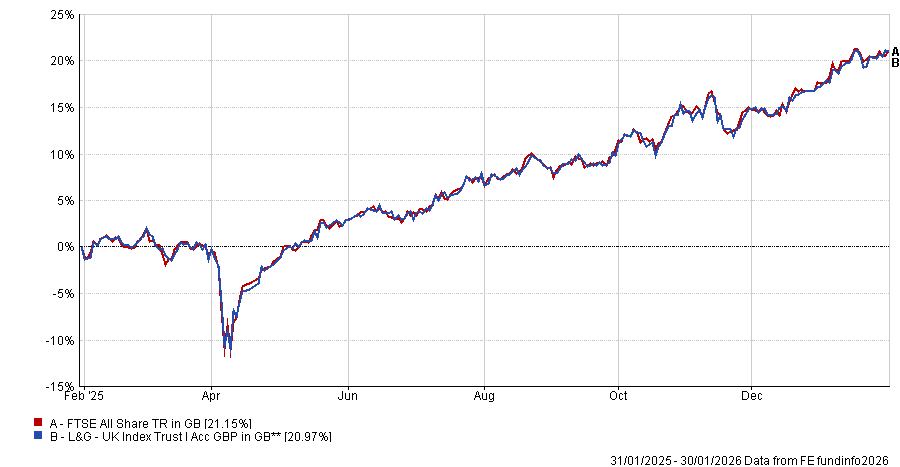
For those wanting to invest in defence stocks, Hargreaves Lansdown suggests Legal & General UK Index, which provides investors with broad exposure to the UK stock market – including notable defence companies, such as Rolls-Royce, which makes engines and other components for a range of military aircraft, naval vessels and defence systems. It is also involved in civil aerospace operations.
It fell 0.2 percentage points short of the FTSE All-Share in the year ending 31 January 2026, gaining 21% versus 21.2%.
Defence currently accounts for 5.9% of the fund. As it is a tracker fund, exposure to the defence sector is determined by each company’s weight in the index and will therefore rise and fall over time.
Performance of the fund vs FTSE All-Share over year ending 31 January 2026
Source: FE Analytics
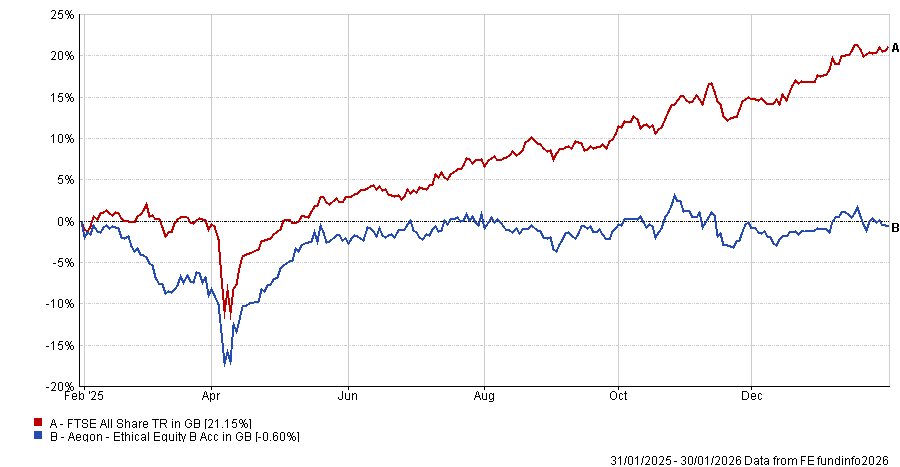
In contrast, investors looking to avoid defence stocks could invest in Aegon Ethical Equity, according to Rowles.
Managed by Audrey Ryan for more than 27 years, the fund utilises a strict exclusions-based approach and will not invest in companies deriving significant revenues from activities such as tobacco, alcohol and gambling.
It also screens out companies involved in the manufacturing of military armaments, nuclear weapons or associated strategic products.
“The fund also won’t invest in companies that operate in countries with poor human rights records if they don’t have solid policies to address this issue,” said Rowles.
The fund lost 0.6% in the year ending 31 January 2026, falling far short of the FTSE All-Share.
Performance of the fund vs FTSE All-Share over year ending 31 January 2026
Source: FE Analytics