






With ISA season entering its final stretch, investors may once again be weighing how much risk they want to take into the new tax year.
Trustnet has recently explored the cautious end of the spectrum for those unsettled by persistent geopolitical tensions and shifting inflation and interest rate expectations, as well as the more aggressive options for investors willing to lean into market momentum despite uncertainty.
For many, the ideal portfolio may land somewhere in the middle – a blend of growth potential with risk control.
Trustnet asked fund pickers which portfolios can deliver this middle-ground resilience.
Jason Hollands, managing director of Bestinvest, suggested the £1.1bn Temple Bar Investment Trust.
Co-managed by Ian Lance and Nick Purves, it utilises a disciplined value approach to outperform the FTSE All Share.
“The bias towards large- and mid-sized financially robust dividend-paying companies combined with value discipline makes this a relatively defensive way to access UK equities,” Hollands said.
The highly researched trust has entered its centenary year having delivered top-quartile returns in the IT UK Equity Income sector for three consecutive years. Last year, it more than doubled the sector average return, gaining 43.8%.
However, it has been flagged as more expensive than many of its peers following a re-rating last year, currently trading at a narrow 2.1% discount to net asset value (NAV).
The trust may be worth the cost due to its increasing dividends.
In its 2025 annual report, Temple Bar paid out 15p per share in 2025 – a third more than the 11.25p paid in 2024. The total was boosted by a 0.75p per share payment from its £929m of capital reserves from historic investment gains, meaning last year’s pay-out was not fully covered by revenues, which rose from 11.8p to 13.8p per share.
It further announced a 4% increase in the quarterly dividends from 3.75p to 3.9p per share in 2026, which would take this year’s total to 15.6p.
When it comes to dividend growth, City of London Investment Trust has a multi-decade track record, having logged annual increases since 1966.
Paul Angell, head of investment research at AJ Bell, said the trust’s focus on providing a blend of income and growth should be appealing to investors of all ages.
“Younger investors may want to reinvest any dividends to enjoy the benefits of compounding, while older investors typically welcome regular dividends to help pay the bills,” he said.
It is more expensive than Temple Bar, trading on a 1.8% premium to NAV, yet offers a competitive 3.9% yield and OCF of 0.37%.
Emma Wall, chief investment strategist at Hargreaves Lansdown, also selected City of London Investment Trust.
“Manager Job Curtis is one of the most experienced UK equity income investors in the industry, running a dividend hero trust invested in quality cash-generative companies,” she said.
Its 78-stock portfolio is anchored in large-cap UK names deriving most of their revenues from overseas, with financials making up more than a third of assets.
Performance of the trusts vs sector over 10yrs
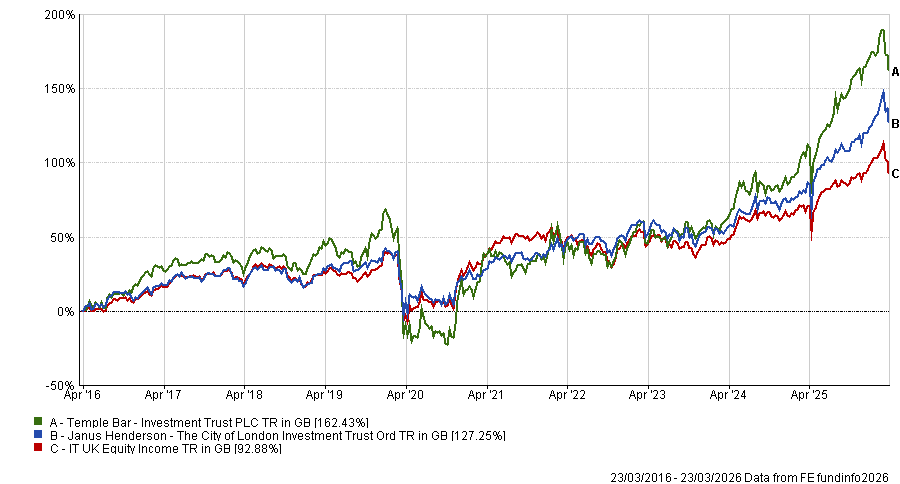
Source: FE Analytics
On the fund side, Angell suggested the £2.4bn Polar Capital Global Insurance – run by Dominic Evans and Nick Martin – as a more specialist option in a balanced ISA.
“The return profile of this equity fund is less correlated than most to global equity markets, thanks to the revenue profile of the invested businesses being predominantly tied to insurance underwriting premiums/margins, which are not typically reliant on prevailing economic conditions and are often tied to regulatory requirements,” he said.
The insurance companies also generate returns through their own investment portfolios. Angell noted these are primarily invested in short-dated bonds, “which remain elevated to benefit company revenues”.
It is a more concentrated fund, with a portfolio of between 30-35 stocks, and is heavily weighted towards commercial insurers, with meaningful allocations to retail and reinsurance.
It should be noted that the fund does charge a 10% performance fee which comes into play when it beats its benchmark, the MSCI Daily TR World Net Insurance index. Over the past decade, the fund has beaten the index in four calendar years.
Polar Capital Global Insurance has also topped the IA Financials and Financial sector in three of the past 10 years.
Meanwhile, Rob Burdett, fund manager at Nedgroup Investments picked Atlas Global Infrastructure to provide diversification to equities and bonds in an investor’s ISA portfolio via its focus on long-term investing in infrastructure equities globally.
He said the fund has “balanced characteristics” which help it to “avoid some of the worst hissy fits in markets”, including the recent volatility surge following the outbreak of the US and Israel’s war with Iran.
The $1.5bn fund holds just 24 stocks across OECD markets, targeting high-quality utilities and essential service providers, with top positions including Pinnacle West Capital and Severn Trent.
At 1.08%, its OCF is higher than many peers.
“It has been a very good, steady performer,” Burdett said. “It did have a tricky period around 18 months ago but the inflation and interest rate environment we are in at the moment is not unsupportive for this area.”
Also targeting diversification beyond a typical 60/40 balance between equities and bonds, Sheridan Admans, founder of Infundly, suggested multi-asset strategy SVS RM Defensive Capital Fund as a “defensive core” to a balanced portfolio.
“Unlike traditional balanced funds, it invests in discounted assets, specialist credit, real assets and diversifiers,” he said.
It is one of the smaller funds picked at £110m and aims for consistent positive returns over rolling three-year periods, utilising a blend of top-down macro analysis and granular security selection. Its three-year return to the end of February 2026 is 37.6%.
Admans pointed to the manager’s valuation-driven approach, noting this creates a “margin of safety and the potential for returns through discount narrowing and asset realisation”.
“This results in a return profile less dependent on market direction and more on underlying asset value,” he said.
Admans said the fund may lag in strong bull markets or when valuations opportunities are scarce.