






Growth and value investing take two radically different approaches but combined can offer investors a good start to diversification according to Tom James, investment analyst at Hargreaves Lansdown.
The former looks for companies that can grow their earnings faster than the market, while the latter puts a greater emphasis on the price paid for companies, hoping to pick up cheap businesses going through a rough patch in expectation of a rebound.
With such a contrast in methods, the styles tend to perform differently under different conditions. Value stocks do well when the market is weaker or soon after a recession when the economy is improving, while growth stocks boom when interest rates are lower.
Below, the Hargreaves analyst outlined three fund pairings in different equity regions that could pair well as part of a diversified investment portfolio.
Global pairings
For those looking to gain exposure globally, he suggested pairing Lazard Global Equity Franchise with Rathbone Global Opportunities.
The former is run by Bertrand Cliquet, John Mulquiney, Matthew Landy and Warryn Robertson, who invest in companies that have a strong competitive advantage, predictable earnings and robust balance sheets.
They use a distinct value investing style, which means the fund can often look different to both the broader stock market and other funds in the global sector.
Conversely, James Thomson has managed Rathbone Global Opportunities since 2003 and looks for companies with strong competitive advantages that have the potential to grow their earnings over the long term.
“Both funds can invest in higher-risk emerging markets and smaller companies,” noted James.
Both funds have struggled year to date, impacting their medium-term returns, but typically perform differently from one another. When the Rathbone fund was in the top quartile of the IA Global peer group in 2019 and 2020, the Lazard fund lagged. The reverse was true in 2022.
An emerging markets duo
For those wanting emerging market exposure, James highlighted the Invesco Global Emerging Markets fund as his preferred value pick. FE fundinfo Alpha Managers Charles Bond and William Lam run the fund alongside Ian Hargreaves, all of whom are contrarians, he said.
They look for out-of-favour companies whose shares are priced lower than they believe they should be and the team can invest in smaller companies, which can increase the risk.
Meanwhile, JPM Emerging Markets invests in high-quality companies that managers Austin Forey, Leon Eidelman and John Citron believe can sustain earnings growth over the long term.
“They consider the financial strength of a business, the quality of the management team and the level of corporate governance,” said James.
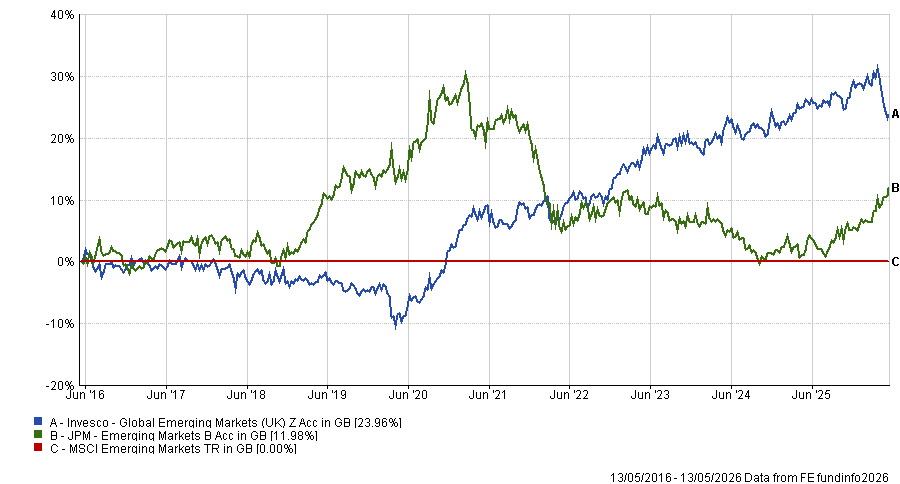
Like the global funds above, the portfolios move very differently from one another, as the chart below shows. The red line is the MSCI Emerging Markets index, while the blue and green lines represent the funds’ relative performances against the benchmark.
Performance of funds relative to the MSCI Emerging Markets index over 10yrs
Source: FE Analytics
When the line for a fund is moving upwards, it means it’s outperforming the benchmark. When it’s going down, it’s underperforming. Both have beaten the index, but tend to have shone at different times, with the Invesco portfolio enjoying the better returns more recently.
Japan
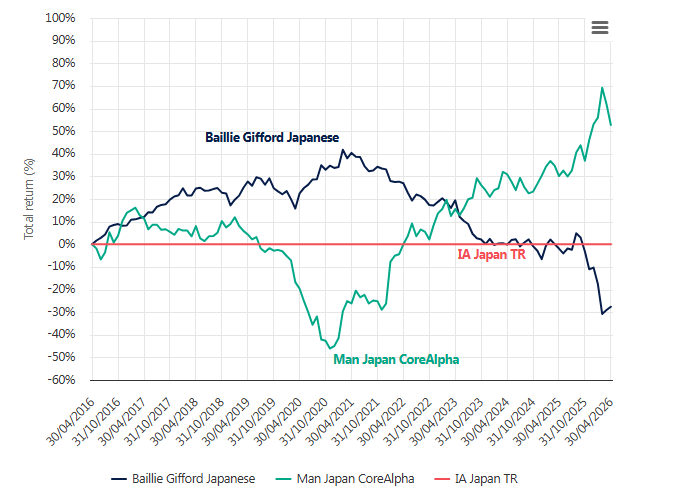
Perhaps the clearest example of where value and growth styles can differ is Japan, where he recommended pairing Baillie Gifford Japanese (growth) with Man Japan Core Alpha (value).
Source: Hargreaves Lansdown
The chart below shows relative fund performance against the IA Japan sector. “While value investing has outperformed growth for much of the past five years, growth was far stronger in the five years before,” said James.
The Baillie Gifford fund is managed by Matthew Brett, who looks for companies at different stages of growth. All, however, must have an adaptable or durable enough competitive advantage that the manager believes could help deliver growth over the next five to 10 years.
Meanwhile, Jeff Atherton’s Man Japan CoreAlpha invests in larger, more-established Japanese companies that are currently out of favour.
“The fund tends to invest in a relatively small number of companies, meaning each one can make a significant contribution, but this increases risk,” noted James.