






The Federal Reserve voted 9-3 on Wednesday to keep the federal funds rate at 3.50%-3.75%, the fifth consecutive hold at this level.
Three regional bank presidents on the Federal Open Market Committee pushed for an immediate quarter-point rise. This was the first time since September 2016 that three FOMC members dissented in the same direction.
Federal Reserve Bank presidents Lorie Logan of Dallas, Beth Hammack of Cleveland and Neel Kashkari of Minneapolis dissented, all preferring a 25-basis-point increase. They argued that inflation, which has remained above the US central bank's 2% target for more than five years, required a firmer response.
Richard Carter, head of fixed interest research at Quilter Cheviot, said: "While there had been speculation that the Federal Reserve would take the nuclear option and in fact raise interest rates at this latest meeting, it continues to leave that option in its back pocket just in case it gets spooked about the path for inflation and has to break the glass."
Federal Funds Effective Rate since 2000
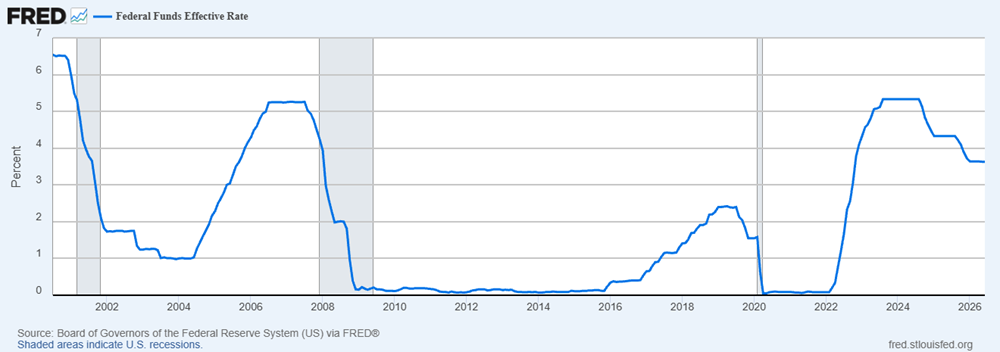
The Fed's statement said economic activity is expanding at "a solid pace", with job gains keeping pace with the workforce and unemployment little changed. It also cited elevated uncertainty tied in part to the conflict between the US and Iran in the Middle East.
Investors broadly agree the Fed's next move is more likely to be a hike than a cut.
Salman Ahmed, global head of macro and strategic asset allocation at Fidelity International, said: "This reinforces our view that the Fed will only engage in a hiking cycle from December, contingent on data remaining tight.
"Markets have reduced their odds of a September hike and appear aligned with our view on the timing of the next hike. However, incoming data and geopolitical developments over the next two months will keep the risks of a September hike alive."
Seema Shah, chief global strategist at Principal Asset Management, said cuts remain off the table for now and "neither can investors rule out another hike before year-end", while Daniele Antonucci, chief investment officer at Quintet Private Bank, said his expectation is that "the central bank will be forced to raise rates later this year".
Fed chair Kevin Warsh continued to avoid forward guidance, deferring policy questions to recommendations from an internal task force. He seems to want markets to focus on incoming data rather than his own remarks, Carter suggested.
Ahmed noted this was consistent with Warsh's recent comments at the European Central Bank's annual gathering in Sintra, Portugal, and his testimony before Congress, adding that the chair welcomed the market volatility ahead of the meeting and characterised higher bond yields as investors learning to "play the ball", effectively doing some of the Fed's job by tightening financial conditions.
"The continued lack of guidance in the face of rising supply-side shocks and inflation pressures reaffirms our view that Warsh's Fed is likely to be more patient and look through building price pressures," Ahmed added.
Carter linked the lack of clarity to the political backdrop: "Warsh is still to set out his strategy when it comes to combatting inflation and the general path for interest rates. Some of that is due to potential dissenting views on the board of the Federal Reserve, but Warsh also appears to want to get markets focusing on the actual economic data, rather than the words he delivers.
"[US president] Donald Trump continues to watch with interest too and, with midterms now under 100 days away, the president will want to deliver positive news on the economy. Inflation continuing to remain elevated and the looming potential for rate hikes certainly makes that narrative difficult to achieve."
The conflict in the Middle East remains the clearest upside risk to inflation, according to Carter, Shah and Antonucci. Carter said price pressures "can return almost as soon as they have dissipated" if the situation escalates and expects inflation to extend its above-target streak "well beyond five years".
Shah says Principal Asset Management's base case is that the Fed stays on hold through the rest of the year as underlying inflation pressures ease. But prolonged energy disruptions would "raise the risk of inflation expectations becoming unanchored, potentially requiring a firmer policy response".
Antonucci pointed to supply-side factors, including tariffs and oil disruptions, as the source of inflation that the Fed's current approach may struggle to address through borrowing costs alone.
Markets showed a clear steepening bias as the odds of a near-term hike fell, though longer-dated yields sold off, Ahmed said. Equity markets were largely unmoved, with investors more focused on hyperscaler earnings released later the same session.
Ahmed described the meeting as delivering "the second-largest Fed surprise in more than a decade", reflecting what he called the elevated uncertainty that comes from the absence of a clearly defined policy framework.
"We expect policy and market volatility to remain high and see this as the new normal in the Warsh era," he added.