






US equities have dominated global markets over the past decade, driven largely by the extraordinary rise of mega-cap technology companies – specifically the Magnificent Seven.
Against this backdrop, the S&P 500 has proven difficult for active managers to beat. Over the 10 years ending March 2026, only 19% of IA North America sector funds outperformed the index, according to FE Analytics data.
Yet, when looking at each calendar year from 2016 to 2025, a small group of active strategies managed to beat the index more often than not. In this series, Trustnet is measuring consistency by the number of calendar years in which funds beat the S&P 500.
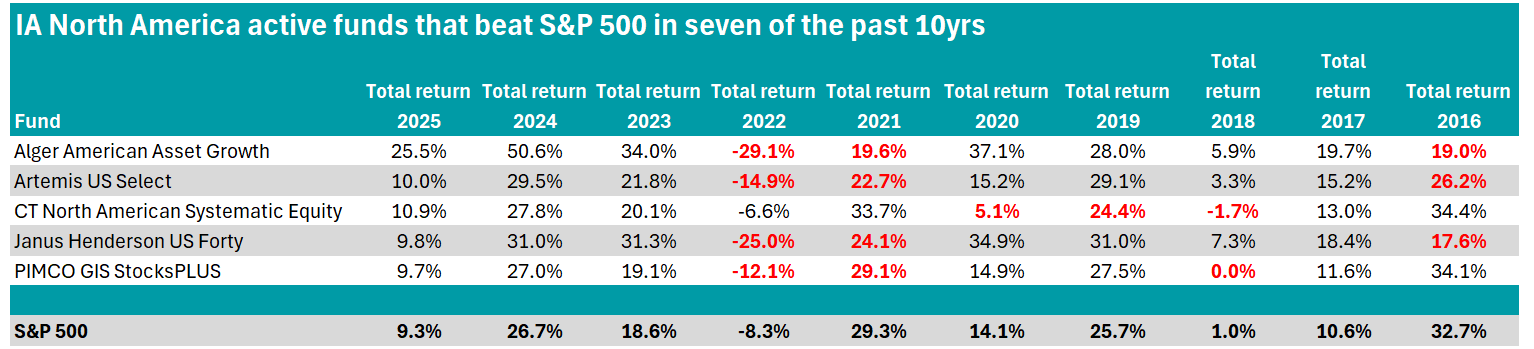
As shown in the table below, five funds outperformed the S&P 500 in seven of the past 10 years.
Source: FE Analytics
Alger American Asset Growth has frequently beaten both the index and its sector over the past 10 years.
The $628.8m strategy delivered the strongest return in the group in 2025, gaining 25.5%, which also placed it third in the IA North America sector overall. It also topped the table in 2024 with a 50.6% gain, finishing second in the sector behind its stablemate Alger Focus Equity.
The fund was again the best performer in the table in 2023 and posted top-quartile sector returns in 2017, 2018, 2019 and 2020.
It is managed by FE fundinfo Alpha Managers Patrick Kelly and Ankur Crawford, alongside Dan Chung. Their process focuses on identifying companies undergoing “positive dynamic change”, supported by detailed fundamental analysis and financial modelling. The portfolio is dominated by mega-cap tech names, including Nvidia, Microsoft, Amazon and Meta.
Earlier this year, Trustnet highlighted the strategy for maintaining top-quartile results in three consecutive calendar years, while it also rebounded sharply after the US tariff-related sell-off in April 2025, rising more than 50% over the following five months.
However, the fund does sit at the higher end of the cost spectrum, with an OCF of 1% as at 31 December 2025.
Another fund that has demonstrated a strong multi-year track record is Janus Henderson US Forty, which has posted a top-quartile return in the sector in six of the past 10 years, as well as beating the S&P 500 in seven years.
It was the best performer in the table of five funds in 2018 and 2019, supported by its high-conviction approach and focus on large-cap growth companies. The $1.2bn portfolio holds 32 stocks with a weighted average market capitalisation of around $1.5trn.
The fund was also recognised last year for achieving seven years of top-quartile Sharpe ratios over a 10-year assessment period.
Co-managers Nick Schommer and Brian Recht have said they believe the multi-year AI adoption trajectory “remains on track”, but beyond AI, they are also “upbeat” on other secular trends such as life sciences innovation, digitisation of both payments and commerce and continued cloud migration.
Although pitted against the S&P 500 in this article, Janus Henderson US Forty aims to outperform the Russell 1000 Growth index by at least 2.5% per year over rolling five-year periods.
Also in the table is the £1.5bn Artemis US Select, which is a 40-60 stock portfolio co-managed by Cormac Weldon and Chris Kent. It is style-agnostic and macro aware, although it has a quality and growth bias.
RSMR analysts described the fund’s philosophy as “clearly defined” and “tried and tested”, noting that its predominantly top-down approach can lead to higher turnover.
The remaining two funds in the table take a structurally different approach to generating consistent results.
With $5.3bn in assets, PIMCO GIS StocksPLUS is the largest fund of the five, combining S&P 500 futures and swaps with an actively managed short-duration bond portfolio.
The strategy, which is managed by Alpha Manager Marc Seidner alongside deputies Jing Yang (also an Alpha Manager) and Bryan Tsu, seeks to outperform the index by generating excess returns over cash from its fixed income holdings, while derivatives provide full non-leveraged exposure to US large-cap equities.
CT North American Systematic Equity also offers a contrasting route to consistency. As the name of the fund suggests, it relies on a systematic process rather than the high-conviction discretionary stock selection approach taken by the Janus Henderson fund.
It delivered the strongest return of the five funds in 2022, limiting its loss to 6.6% – outperforming both the S&P 500 and the majority of its sector peers in a difficult year for equity markets.
The strategy also posted a first-quartile return in 2021 and was one of the most bought US funds in 2025.
Passive funds
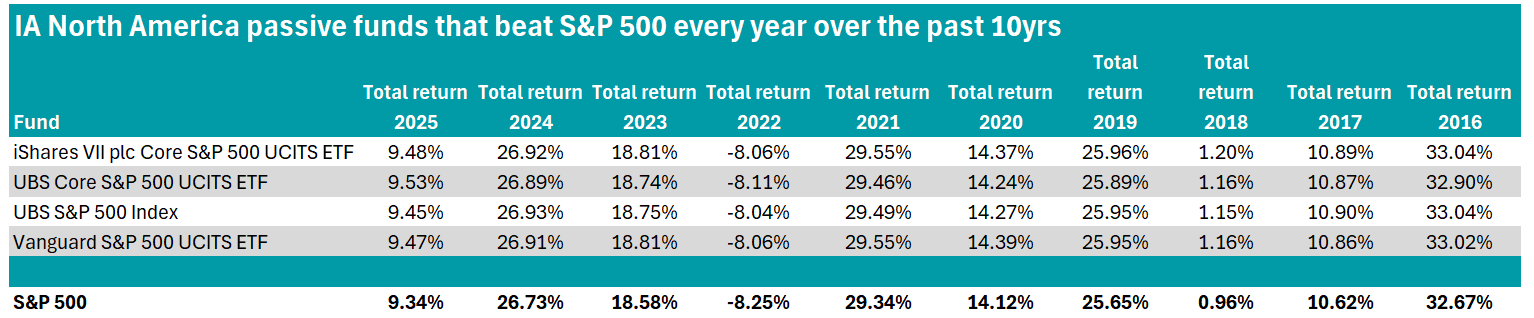
While only a handful of actively-managed funds beat the S&P 500 in a maximum of seven years, the picture looks different among passive strategies. As shown in the table below, four passive funds in the sector outperformed the index in all 10 years.
Source: FE Analytics
Passive funds are designed to replicate their chosen index as closely as possible and typically charge far lower fees than active managers.
However, repeated outperformance relative to the benchmark should be interpreted with some caution. Outperformance can come from their slightly different stock weightings or the undertaking of securities lending.