






Two actively managed funds in the IA Global Emerging Markets sector have combined low costs with high returns over the past decade, Trustnet research has found.
As part of an ongoing series, we screened Investment Association (IA) sectors for funds that sit in the cheapest decile of actively managed strategies while also ranking in the top decile of their sector for 10-year returns to the end of May 2026.
The idea is that, for investors, cheaper active funds can offer a middle ground between low-cost passive exposure and the potential for excess returns from skilled managers.
In the IA Global Emerging Markets sector, it paid to hunt for deals: over the past decade, the least expensive active funds delivered an average return of 253.9%, compared with 158.5% from the most expensive.
However, only two of these funds met the specific criteria for being in the cheapest decile and the best-performing decile: Nomura Emerging Markets and Invesco Global Emerging Markets (UK).

Source: FE Analytics
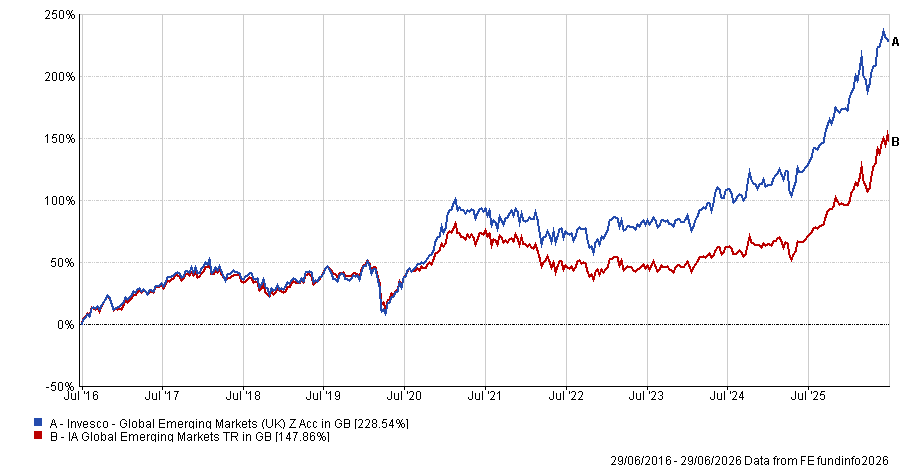
Invesco Global Emerging Markets (UK) has proven to be an affordable long-time outperformer in the IA Global Emerging Markets sector. The £1.4bn strategy, launched in 2012, has an OCF of 0.75% and a 10-year total return of 261.8%.
It holds a five-star FE fundinfo Crown Rating and is managed by Alpha Managers Charles Bond and William Lam, alongside Ian Hargreaves and Matthew Piggott, who apply a value-oriented philosophy centred on identifying undervalued companies in areas of the market that have fallen out of favour. Their preference for cash-generative businesses with robust balance sheets has resulted in a 61-stock portfolio with a weighted average market capitalisation of £2.4bn.
As well as logging a first-decile 10-year return, the fund has a strong shorter-term track record, as it was in the first decile for returns in the sector in 2025, gaining 31.8%.
Analysts at Titan Square Mile noted that significant inflows in 2025 prompted the management team to raise both its market cap threshold and minimum daily liquidity requirements, pushing the Invesco strategy toward large, more liquid names and reducing its ability to take meaningful positions in smaller, higher-conviction ideas. As such, the portfolio’s current larger positions include TSMC, Samsung and MediaTek.
Invesco Global Emerging Markets (UK) has also attracted the attention of fund selectors and investment platforms. In May 2026, Hargreaves Lansdown analyst Tom James suggested pairing the strategy with JPM Emerging Markets to balance its valuation discipline with a quality-growth approach.
Meanwhile, Darius McDermott, managing director at Chelsea Financial Services, highlighted the fund as the one he would buy if emerging markets sold off, citing its blend of strong valuation discipline and fundamentally sound companies that have been mispriced by the market.
Performance of the fund vs sector over 10yrs
Source: FE Analytics
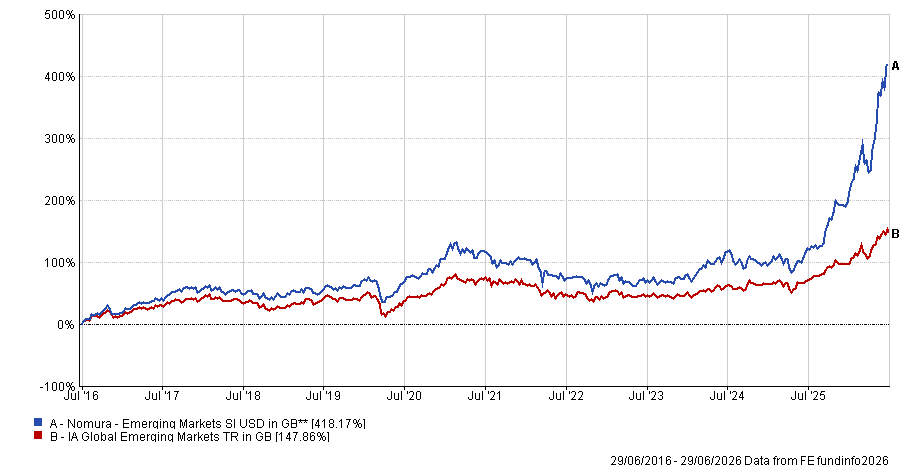
However, the strongest performer, and the cheapest of the two funds, is Nomura Emerging Markets, which combines a low ongoing charge of 0.55% with the highest 10-year return in the IA Global Emerging Markets sector at 438%.
The $1.5bn strategy is managed by Liu-Er Chen and aims to ensure long-term capital appreciation through a broad portfolio of emerging market equities.
Nomura Emerging Markets’ portfolio currently consists of 66 stocks and has its largest allocation to the information technology sector, although it is technically underweight relative to the benchmark at 39.1% versus 43.2%, while industrials (15.6%) and financials (14%) form the next largest sector exposures.
Geographically, the strategy is heavily overweight South Korea (36.3% versus 23.1% for the benchmark) and underweight China (11.5% versus 20.4%). Its top holdings highlight this geographic focus, with SK Hynix and Samsung taking up 9.9% and 9.4% of the portfolio respectively.
Although the fund launched in its current form on 31 January 2020, this was the result of a merger with the Delaware Investments Emerging Markets fund, an Irish UCITS. The merger transferred the predecessor fund’s track record, giving the strategy a longer history than the launch date suggests.
It should also be noted that the Delaware Investments Emerging Markets fund was more expensive – Class F shares had a 1.70% OCF and Class I shares had an 0.95% OCF.
However, Nomura Emerging Markets’ short-term track record is equally strong, gaining 68.3% so far in 2026 – placing it in the first decile of the sector – while it is also in the first decile over one, three and five years.
The fund was also identified as one of six in the sector that has beaten the MSCI Emerging Markets index in at least 10 of the past calendar years to the end of 2025.
Performance of the fund vs sector over 10yrs
Source: FE Analytics
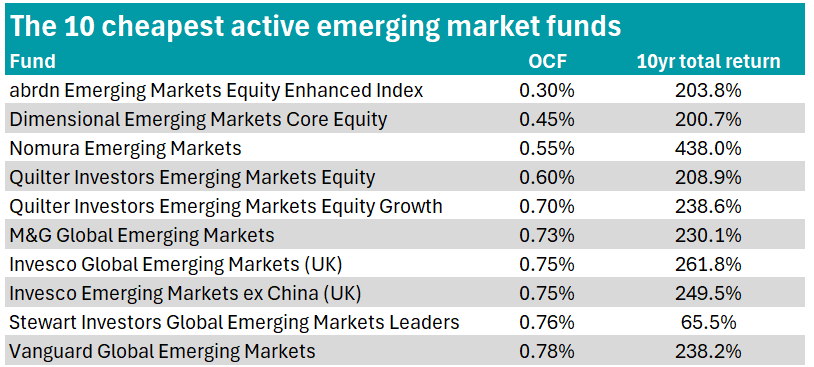
The cheapest actively-managed emerging markets funds
While Invesco Global Emerging Markets (UK) and Nomura Emerging Markets are the only funds that combine the lowest fees with top-decile 10-year returns, there are other strategies in the sector that stand out purely on cost.
Source: FE Analytics
The cheapest is Abrdn Emerging Markets Equity Enhanced Index, with an OCF of 0.30% and a 10-year return of 203.8% – placing it in the fourth decile of the sector.
The £174.5m strategy aims to generate long-term growth in excess of the MSCI Emerging Markets 10/40 index over rolling five-year periods. While it incorporates this active overlay, the fund’s long-term risk profile remains close to the benchmark, with a targeted tracking error of less than 1.25% over reasonable timeframes. This places it in the grey area between active and passive – but because of its explicit active objective, it qualifies for inclusion in this screen.
RSMR analysts said: “The abrdn enhanced index funds bring together the benefits of both active and passive management in a low-cost proposition.”
Other cheaper active funds also included in the table are Dimensional Emerging Markets Core Equity and M&G Global Emerging Markets.
The actively managed emerging market funds with the strongest returns
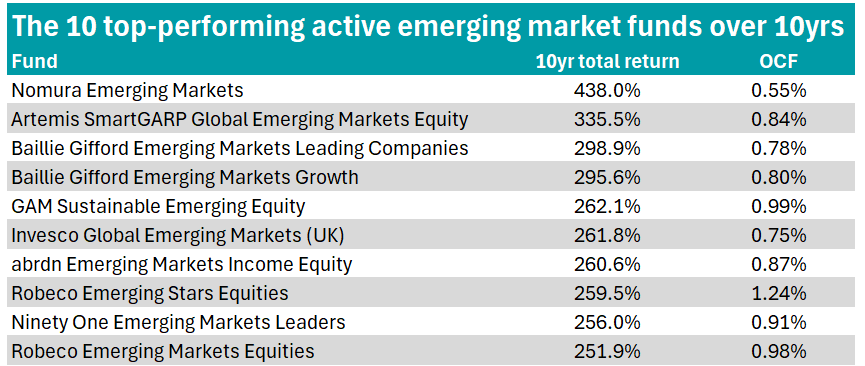
Of course, cost is only one side of the equation. When looking purely at performance, the IA Global Emerging Markets sector has a different set of leaders – although Nomura Emerging Markets still tops the list.
Source: FE Analytics
With the Nomura strategy already covered, the next best-returning fund in the sector over the assessed timeframe is the £2.8bn Artemis SmartGARP Global Emerging Markets Equity fund, with a 10-year return of 335.5% in exchange for a 0.84% OCF.
The strategy has been managed by Alpha Manager Raheel Altaf since 2015 and is built around Artemis’ proprietary SmartGARP process, which aims to strip out behavioural biases when assessing investment opportunities. It invests across emerging markets in themes such as technological innovation, infrastructure development and the rise of domestic consumer brands.
The fund has recently attracted strong investor interest. It was added to the FundCalibre Elite Ratings list in April 2026 and was the most bought fund in the IA Global Emerging Markets sector in 2025, drawing $586.4m in net new money while performance added $457.4m.
Other funds included in the table are Baillie Gifford Emerging Markets Growth and GAM Sustainable Emerging Equity.